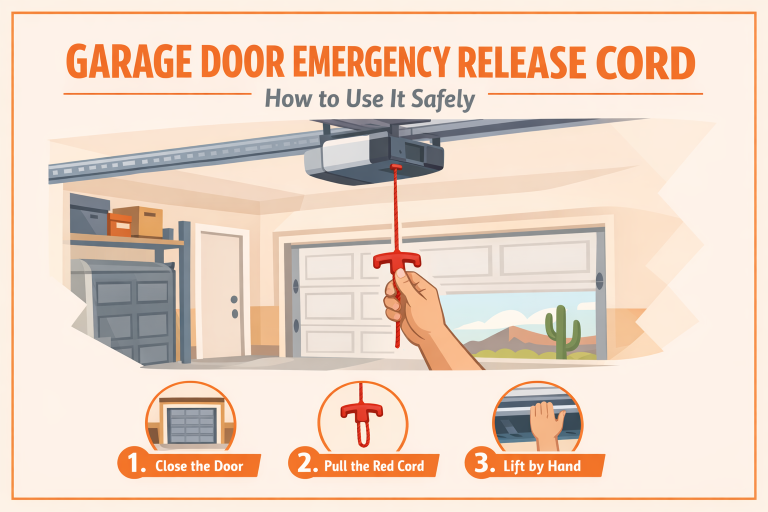
Homeowner pulling the red garage door emergency release cord, with safety steps — CallOrange Garage Door Repair, Tempe AZ

Stuck Inside? How to Use Your Garage Door Emergency Release Cord Safely

The garage door emergency release cord is the bright red rope hanging from your opener’s rail, and it exists for a single purpose: to disconnect the door from the motor so you can raise or lower it by hand when the power is out or the opener quits. Used correctly, it takes seconds. Used at the wrong moment, it can let a heavy door fall.

A summer storm knocks the power out across your Tempe neighborhood, the opener falls silent, and your car is trapped behind a door that won’t budge — with somewhere you need to be. That exact scenario is what the garage door emergency release cord was built for, and pulling it safely is far simpler than most homeowners expect. At CallOrange Garage Door Repair, we’ve coached thousands of Valley households through this moment since 2008. We’ll show you what the red handle actually does, when it’s safe to use, and the one situation where pulling it can cause real harm. If you’d rather have help on the way while you read, you can find our Tempe location on Google Maps.

Garage Door Emergency Release Cord: What It Is and Why Every Door Has One

The garage door emergency release cord is a short rope with a red handle connected to the trolley — the carriage that travels along your opener’s rail and pushes the door up and down. Pulling the handle trips a spring-loaded lever that separates the door’s arm from that trolley, switching the door from powered operation to manual. Once disconnected, the door is no longer held by the motor; it’s held only by its springs, which is exactly why understanding the system before you tug on anything matters.

Every automatic opener sold in the United States — whether it’s a LiftMaster, Chamberlain, or Genie — ships with this release by federal design standard. It’s the same mechanism whether you own a chain-drive unit from the 1990s or a Wi-Fi model wired into your smart home integration. Our factory-trained technicians work with all of them, and the release operates on the same principle across the board.

Where to Find It on Your System

Look up at the rail running from the wall or ceiling motor toward the door. The red handle hangs from a small trolley roughly in the center of that rail. In most homes it dangles six to seven feet off the ground — high enough that it isn’t an everyday object, low enough to reach without a ladder. If you’ve never noticed it, you’re in good company; many of the homeowners who call our garage door service team are surprised it was there all along.

Why Building Codes Require It

The release exists for safety, not convenience. If anyone is ever trapped inside a garage during a fire or power loss, that cord is the manual override that gets the door open. It also protects the opener motor itself — forcing a powered door open or closed can strip the gears and burn out the unit. Knowing how to disengage it cleanly is part of basic home ownership, much like knowing where your water shutoff valve is.

When the Emergency Release Cord Helps — and When to Stop

Situation Safe to Use the Cord? What to Do
Power outage, door looks normal ✓ Yes Release, operate by hand, re-latch when power returns
Opener motor dead, door sits level ✓ Yes Use the cord, then schedule an opener repair
Remote or keypad not responding ✓ Yes Use the cord; check batteries and the opener
Door stuck open, but looks normal ✓ With care Support the door, release, lower it gently
Loud bang, door now crooked or very heavy ✗ No Likely a broken spring — call a professional
Door has come off the track / leaning ✗ No Don’t pull the cord — call a professional
Frayed, loose, or hanging cable ✗ No Stop — cable is under tension; call a pro
Bent panels, hardware, or rollers ✗ No Have it inspected before operating the door

When to Pull the Cord — and the One Time You Shouldn’t

Most of the time, the garage door emergency release cord is exactly the right tool. Reach for it confidently when the power is out, when the opener has died but the door itself looks normal, or when a remote or wall button has failed and you simply need to get the car out. In each of these cases the door is mechanically sound — only the powered drive is offline.

There is, however, one situation that changes everything: a broken torsion spring. Your springs, not the opener, carry the real weight of the door. When a torsion spring snaps — often with a bang loud enough to wake the house — the opener may be the only thing still holding the door up. Pull the release in that moment and the door can drop with enough force to injure anyone beneath it and crack the panels. The same caution applies to a door that has come off its track, a frayed or hanging cable or roller, or visibly bent hardware.

How can you tell? A healthy door sits level, and the springs above it look intact and tightly wound. A door with a snapped spring often hangs crooked, shows a clear gap in the spring coil, or feels impossibly heavy to lift. When anything looks off, leave the cord alone and call our emergency repair team instead.

⚠️ Safety Warning: High-Tension Springs & Electrical Hazards

Garage door torsion springs are wound under extreme tension — enough stored energy to cause severe injury or death if a spring, cable, or winding bar slips. Opener units also connect to 120V AC household wiring. Never attempt to adjust, wind, or replace springs, cables, or opener wiring yourself, and never pull the emergency release on a door you suspect has a broken spring. The U.S. Consumer Product Safety Commission (CPSC) links thousands of garage door injuries each year to spring failures and improper repairs. When in doubt, hire a licensed, insured garage door technician. Every CallOrange technician is licensed, insured, and trained to handle these components safely.

How to Use Your Garage Door Emergency Release Cord Safely, Step by Step

When the door is sound and you’ve ruled out a broken spring, releasing it by hand takes under a minute. Here is the process our technicians teach every customer.

Step 1 — Lower the Door First if You Can

Whenever possible, disconnect the release while the door is fully closed. A closed door rests on the floor, so there’s no stored height for it to fall from and no chance of it dropping. If the power died with the door open, support the door or have a second person help before you pull the handle — and never stand directly beneath a raised door as you release it.

Step 2 — Pull the Red Handle Straight Down

Grip the red handle and pull it straight down in one firm motion. You’ll feel the lever click as the trolley separates from the door arm. Pulling down rather than at an angle keeps the mechanism from binding and makes reconnecting easier later.

Step 3 — Operate the Door by Hand

With the opener disengaged, lift the door using the lift handles or the bottom edge, raising it smoothly to fully open. A properly balanced door will glide and stay where you leave it. If it feels extremely heavy or wants to slam shut, that’s a sign the springs are doing too little — stop, lower it gently, and call a professional. When you’re finished, lower the door fully so your home stays secure.

Step 4 — Reconnect the Opener

Once power returns, re-engage the trolley. On most LiftMaster, Chamberlain, and Genie units you simply pull the red handle back toward the door (or straight down again, depending on the model) until the lever re-locks, then run the opener through one full cycle. The trolley clicks back into the carriage automatically as the door moves. If it won’t re-latch, our opener repair specialists can reset it quickly.

Why Openers and Doors Fail When You Least Expect It

Understanding why you ended up reaching for that cord helps you prevent the next emergency. Across the Phoenix metro, a handful of regional factors put unusual stress on garage systems.

Arizona heat is the first culprit. Attached garages routinely climb past 120°F in summer, which thins factory grease, hardens the nylon on rollers, and bakes the electronics inside the opener’s logic board. Power surges from monsoon storms are the second — a single surge can fry an opener’s circuit board and leave you depending on the manual release until a replacement arrives. The third is simple wear: every torsion spring is rated in cycles, and a busy family opening the door several times a day can exhaust that rating in just a few years.

Brand and age matter, too. A modern LiftMaster with myQ or a Genie running Aladdin Connect behaves differently from a twenty-year-old chain drive, and resetting a connected unit after a manual release sometimes calls for re-syncing the app. Our team works across every major brand daily, which is why we can talk a customer through a smart-opener reset as easily as an older model — and why we cover the full range in our guide to garage door home automation.

None of this is only about getting the car out. A door that opens evenly and seals tightly protects your curb appeal, reinforces your home security by latching reliably every night, and — paired with insulated panels — helps your garage hold temperature against the desert heat. The release cord is your backup; a well-maintained door is what keeps you from needing it.

Preventing the Next Garage Door Lockout

The best way to handle a manual release is to rarely need one. A few practical upgrades dramatically cut the odds of getting stuck again.

The biggest one is a battery backup opener. Many newer LiftMaster and Chamberlain models include an integrated backup battery that keeps the door working through a power outage — the exact scenario that sends most homeowners hunting for the red cord. If your opener is more than a decade old, our opener installation team can tell you whether a backup-equipped upgrade makes sense for your home.

A quality surge protector on the garage circuit is a smart, low-cost second layer, especially heading into monsoon season when lightning-driven surges take out opener boards across the Valley. And nothing beats a routine inspection: a yearly garage door tune-up catches the worn spring, fraying cable, or tired opener gear before it strands you. We keep maintenance histories for our regular clients so we can replace parts on a schedule that suits you — not on the door’s worst possible day. You’ll find more seasonal guidance on our blog.

Manual Operation vs. Calling a Professional: Making the Right Call

There’s a clear line between what’s safe to handle yourself and what calls for a trained, insured technician. Releasing a sound door, operating it by hand, and reconnecting the opener are well within any homeowner’s ability. Diagnosing why the door failed — and anything involving springs, cables, or electrical components — is not.

The reason is simple: torsion springs store enormous energy and are responsible for the most serious garage door injuries in the country every year. The same goes for cables under load and 120V opener wiring. Our certified technicians carry the tools, training, and insurance to handle those components safely, and we’d always rather you call than risk it. The table below shows where that line falls.

Safe to Do Yourself vs. Best Left to CallOrange

Task Safe to DIY? Best Left to a Pro
Pulling the release on a sound door ✓ Yes
Operating a balanced door by hand ✓ Yes
Reconnecting the opener trolley ✓ Usually We’ll reset it if it won’t latch
Diagnosing why the opener failed Limited ✓ Full diagnostic
Adjusting or replacing torsion springs ✗ Never ✓ Licensed, insured techs
Repairing or replacing cables ✗ Never ✓ Pro only
Opener circuit board or wiring repair ✗ Never ✓ Pro only
Realigning a door that’s off track ✗ Never ✓ Pro only
Annual safety & balance inspection Limited ✓ Recommended yearly

If you’re ever unsure which side of that line you’re on, the safest move is a quick call to our service team. We offer 24/7 emergency dispatch across Tempe and the greater Phoenix area, and you can always reach us through our contact page or stop by our shop on Google Maps.

Frequently Asked Questions — Garage Door Emergency Release Cord

What does the garage door emergency release cord do?

The red release cord disconnects your door from the opener’s trolley so you can raise or lower it by hand. It’s designed for power outages or opener failures, letting you operate the door manually until the opener is working again.

Is it safe to pull the release cord while the door is open?

Only with care. A raised door can fall once it’s disconnected from the opener, so support it or have a second person help, and never stand directly beneath it. Whenever possible, release the door while it’s fully closed. If you’re unsure, our Tempe team can talk you through it.

Why shouldn’t I use the release cord if a spring is broken?

Your torsion springs carry the door’s weight. If a spring snaps, the opener may be the only thing holding the door up — pulling the release then can let it crash down. If the door is crooked, extremely heavy, or you heard a loud bang, leave the cord alone and call a professional.

How do I reconnect my opener after using the release?

Once power returns, pull the red handle back toward the door (or straight down again, depending on the model) until the lever re-locks, then run the opener through one cycle. The trolley re-latches automatically as the door moves. If it won’t reconnect, our opener specialists can reset it the same day.

Will the emergency release work during a power outage?

Yes — that’s exactly what it’s for. The release is purely mechanical and needs no electricity. Many newer LiftMaster and Chamberlain openers also include a battery backup that keeps the door powered through an outage. Ask our service team whether a backup-equipped opener is right for your home.

My release cord is stuck or won’t reconnect — what now?

Don’t force it. A stuck release can point to a bent trolley, a worn lever, or a deeper mechanical issue. Our technicians can inspect and reset it safely — book a visit or find us on Google Maps.

Keep Your Family Moving When the Power Cuts Out

A dead opener doesn’t have to mean a trapped car or a missed morning. Knowing how your garage door emergency release cord works — and, just as importantly, knowing the one time not to touch it — turns a stressful surprise into a thirty-second fix. The red handle is a remarkably well-engineered safety feature, and a little familiarity with it is one of the most useful things you can know about the largest moving part of your home. For the bigger picture on keeping that system dependable year-round, our breakdown of what happens during a professional garage door tune-up is a natural next read.

At CallOrange Garage Door Repair, every service call is handled by background-checked, factory-trained technicians who work on LiftMaster, Chamberlain, and Genie systems throughout Tempe. Whether you need a fast opener repair, a torsion spring replacement, or just a second opinion on whether that cord is safe to pull, we’re a phone call away. Call us at (480) 690-3344, seven days a week from 7 AM to 11 PM, with 24/7 emergency dispatch. You can schedule service online in under a minute, or visit our Tempe location on Google Maps at 2101 E Broadway Rd, Suite 3. When the power cuts out, we’ll make sure your door — and your family — keeps moving.

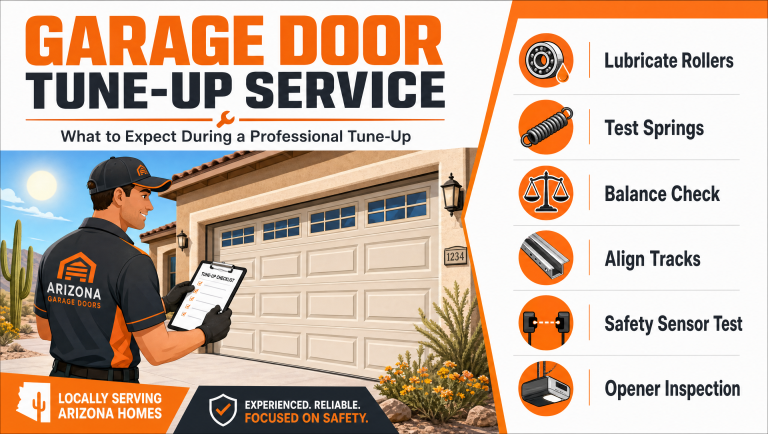
Professional garage door tune-up service checklist banner by CallOrange in Tempe, AZ

Garage Door Tune-Up Service: What to Expect During a Professional Tune-Up

The door groans halfway up, jerks, then thuds against the floor a little harder than it used to. You tell yourself you’ll deal with it later — until the morning it stops halfway and won’t budge with the car already running. That slow decline almost never fixes itself, but it is highly preventable. A scheduled garage door tune-up service catches the small problems while they are still small, and below we walk you through exactly what a professional visit looks like so you know precisely what you’re paying for.

At CallOrange Garage Door Repair, we’ve serviced thousands of doors across the Valley since 2008, and the pattern is remarkably consistent: the doors that get a regular tune-up rarely become the emergency calls. We want to show you why that is, what our technicians actually do during a visit, and how to tell when your own door is overdue. You can also find our Tempe location on Google Maps if you’d like to confirm our service area before reading on.

What a Garage Door Tune-Up Service Actually Includes

A professional garage door tune-up service is a structured, multi-point inspection and adjustment of every moving and load-bearing component of your door system — not a quick spray of lubricant and a wave goodbye. The goal is to restore the door to factory-smooth operation, correct the wear that has crept in since the last visit, and flag any part that is approaching the end of its service life before it fails.

A complete tune-up covers four interconnected systems that all have to work together: the counterbalance system (springs, cables, and drums), the guidance system (rollers, hinges, and tracks), the drive system (the opener motor, rail, and logic board), and the safety system (photo-eye sensors and auto-reverse). When any one of these drifts out of specification, it quietly overloads the others. A door with a fatigued spring, for example, forces the opener to lift more weight than it was rated for, which shortens the motor’s life and strains the rail.

Our team treats every visit as a diagnostic appointment first and an adjustment second. We’ve published a full breakdown of our professional garage door services so you can see how a routine tune-up connects to repairs like torsion spring replacement or track realignment when they’re needed.

The Core Checklist

Every CallOrange tune-up follows the same baseline checklist before any door-specific work begins:

  • Balance test — disconnecting the opener and lifting the door by hand to confirm the springs are carrying the weight correctly.
  • Spring and cable inspection — checking torsion springs for fatigue, rust, and gaps, and cables for fraying.
  • Roller and hinge check — examining rollers for flat spots, cracked nylon, or worn bearings.
  • Track alignment — verifying tracks are plumb, level, and free of dents.
  • Hardware tightening — torquing every bolt, bracket, and lag screw that vibration has loosened.
  • Lubrication — applying the correct lubricant to springs, rollers, hinges, and the opener rail.
  • Opener and safety test — running the opener through a full cycle and testing the auto-reverse and photo-eyes.

What a Professional Tune-Up Covers — and Why It Matters

Tune-Up Step What We Do Why It Protects You
Balance Test Disconnect opener & lift door by hand Confirms springs carry the weight, not your motor
Spring & Cable Check Inspect torsion springs and cables for wear Prevents sudden, dangerous spring failure
Roller & Hinge Inspection Examine for flat spots, cracks, worn bearings Stops grinding and binding before it spreads
Track Alignment Verify tracks are plumb, level, and dent-free Keeps the door from jamming or coming off track
Hardware Tightening Re-torque every bolt, bracket, and lag screw Reverses the loosening caused by daily vibration
Lubrication Apply correct lubricant to all moving parts Restores quiet operation; fights Arizona heat & dust
Opener Calibration Reset travel limits and force settings Door seals fully and stops at the right points
Safety System Test Test auto-reverse and photo-eye sensors Ensures the door reverses for people, pets, and cars
Panel & Weather Seal Check Inspect panels and bottom seal condition Protects curb appeal, security, and energy efficiency

Why Garage Doors Drift Out of Tune

Understanding why a door declines helps you see why preventive service pays for itself. A residential garage door is the largest and heaviest moving object in most homes, and in the Phoenix metro it operates under conditions that accelerate wear far beyond the national average.

The Cycle Count Problem

Garage door springs are rated in cycles — one cycle equals one full open and one full close. A standard torsion spring is rated for roughly 10,000 cycles. That sounds like a lot until you count real usage: a busy family opening and closing the door four to six times a day will burn through that rating in four to seven years. Once a spring passes its cycle life, it doesn’t fail politely — it snaps, often with a bang loud enough to be mistaken for a gunshot, and the door becomes dangerously heavy in an instant.

Arizona Heat, Dust, and Thermal Cycling

Tempe summers are punishing on garage hardware. Daytime temperatures inside an attached garage routinely climb past 120°F, and that heat thins out factory grease, bakes the nylon on rollers, and expands and contracts metal components every single day. Fine desert dust then settles into the dried-out bearings and tracks, acting like a grinding paste. This combination is exactly why our roller replacement and track service requests spike every summer. Regular lubrication during a tune-up is the single most effective defense against this regional wear pattern.

Vibration and Settling

Every cycle sends a small shudder through the door’s hardware. Over hundreds of cycles, that vibration backs out lag screws, loosens hinge bolts, and lets brackets shift. A loose track bracket lets the track drift out of alignment, which makes the rollers bind, which makes the opener work harder — a cascade that starts with a single quarter-turn of play in one bolt. Catching and re-torquing that hardware is routine during a tune-up and prevents the cascade entirely.

Why DIY Often Misses the Real Problem

Homeowners frequently lubricate the noisy parts and consider the job done, but noise is a symptom, not the cause. The grinding sound may be coming from a roller, but the reason the roller is failing might be a track that’s a sixteenth of an inch out of plumb, or a spring that’s no longer balancing the load. Diagnosing the root cause is what separates a professional garage door tune-up service from a weekend spray-down. Our certified technicians are trained to trace symptoms back to their source.

⚠️ Safety Warning: High-Tension Springs & Electrical Hazards

Garage door torsion springs are wound under extreme tension — enough stored energy to cause severe injury or death if a spring, cable, or winding bar slips during adjustment. Opener units also connect to 120V AC household wiring. Never attempt to adjust, wind, or replace springs, cables, or opener wiring yourself. The U.S. Consumer Product Safety Commission (CPSC) links thousands of garage door injuries each year to spring failures and improper repairs. Always hire a licensed, insured garage door technician for spring, cable, or electrical work. Every CallOrange technician is licensed, insured, and trained to handle these components safely.

Our Step-by-Step Professional Tune-Up Process

When you book a tune-up with our team, here is exactly what happens from the moment we arrive. Transparency is part of how we work — you’re welcome to watch every step.

Step 1 — Visual and Operational Assessment

We begin by running the door through a normal cycle while it’s still connected to the opener, listening and watching for hesitation, grinding, jerking, or uneven movement. This shows us how the system behaves under power before we start isolating components.

Step 2 — Manual Balance Test

We disconnect the opener using the emergency release and lift the door by hand to roughly waist height. A properly balanced door will hold its position; a door that slams down or shoots up is telling us the torsion springs are out of adjustment or losing tension. This test is the heart of any honest tune-up.

Step 3 — Hardware and Component Inspection

We inspect the springs, cables, drums, rollers, hinges, brackets, and tracks one by one. We also check the door panels themselves for cracks, separation, or stress fractures that can signal a deeper structural issue and may call for panel replacement.

Step 4 — Adjustment and Tightening

We re-torque all hardware to specification, adjust the track alignment, fine-tune spring tension when it’s within safe limits, and reset the opener’s travel and force settings so the door stops and seals correctly at both ends of its travel.

Step 5 — Lubrication

We apply a lithium-based or silicone lubricant — never WD-40, which is a solvent that strips grease rather than providing it — to the springs, bearings, rollers, hinges, and opener rail. This is what restores that quiet, smooth glide.

Step 6 — Safety System Verification

Finally, we test the federally mandated safety features: the auto-reverse mechanism (the door must reverse when it contacts an object) and the photo-eye sensors near the floor. A tune-up that skips this step isn’t complete. If your opener is older than the 1993 safety standard, we’ll tell you honestly and explain your options.

Professional Tune-Up vs. DIY Maintenance

There’s real value in homeowner maintenance, and we encourage it — keeping tracks clear and listening for new noises genuinely helps. But there’s a clear line between what’s safe to do yourself and what requires a trained, insured technician with the right tools.

Light maintenance you can safely handle includes wiping down the tracks, visually checking the cables for obvious fraying, testing the auto-reverse by laying a block of wood in the door’s path, and lubricating the rollers and hinges with a proper garage door lubricant. What you should never attempt is adjusting or replacing torsion springs, repairing cables, or modifying the spring tension — these components store enormous mechanical energy and are responsible for the most severe garage door injuries every year.

Brand matters here, too. Modern openers from LiftMaster, Chamberlain, and Genie each have proprietary force-adjustment procedures, travel-limit settings, and diagnostic codes. A LiftMaster with myQ connectivity, for instance, behaves differently from an older chain-drive Genie, and resetting the limits incorrectly can leave the door failing to close or reversing for no reason. Our technicians work across all major brands daily, which is why we can tune a modern smart opener as confidently as a twenty-year-old unit. If you’ve been weighing a newer connected model, our guide to garage door home automation explains how smart home integration ties into opener maintenance.

A professional garage door tune-up service also protects more than the mechanics. A door that opens evenly and seals tightly supports your home’s curb appeal, reinforces your home security by closing and latching reliably every time, and — with a properly weather-sealed door — helps your garage hold temperature, which matters more if you’ve invested in insulated garage doors.

How Often Should You Schedule a Tune-Up?

For most Tempe households, we recommend a professional tune-up once a year. Homes with heavy daily use — multiple drivers, a door that doubles as the main entry, or a household running several cycles a day — benefit from a twice-yearly schedule, ideally once before the brutal summer heat sets in and once after.

Beyond the calendar, your door will tell you when it needs attention. Schedule a visit promptly if you notice any of the following: the door has become noticeably louder, it moves unevenly or jerks during travel, it sags or hangs crooked when partway open, the opener struggles or strains, or you hear a loud bang from the garage (a classic sign of a snapped spring). Any of these is worth a call to our service team rather than a wait-and-see approach.

A consistent maintenance rhythm is also the cheapest insurance you can buy for the system. The cost of an annual tune-up is a small fraction of an emergency spring or panel repair, and a far smaller fraction than replacing an opener motor that burned out lifting an unbalanced door. We keep maintenance histories for our regular clients so we can predict component wear and replace parts on your schedule, not on the door’s worst possible day. You’ll find more seasonal care tips on our blog.

Frequently Asked Questions — Garage Door Tune-Up Service

How long does a professional garage door tune-up take?

A standard residential tune-up takes about 45 minutes to an hour for a single door. If our technician finds a component that needs repair — such as a worn torsion spring or a damaged roller — we’ll explain the issue and the cost before doing any extra work. The inspection and adjustment themselves are quick; we never rush the safety tests.

How often should I schedule a garage door tune-up service in Tempe?

Once a year is right for most homes. Households with heavy daily use should consider twice a year — once before summer and once after — because Arizona heat and dust accelerate wear on rollers, bearings, and lubricant. If your door has gotten louder or rougher, don’t wait for the schedule; book a visit sooner.

Can I do a garage door tune-up myself?

You can safely handle light maintenance — wiping tracks, lubricating rollers and hinges, and testing the auto-reverse with a block of wood. What you should never attempt is adjusting or replacing torsion springs, repairing cables, or modifying spring tension. Those components store enormous energy and cause the most serious garage door injuries each year. Leave them to a trained, insured technician.

What are the warning signs my garage door needs a tune-up?

Watch for increased noise, jerky or uneven movement, the door sagging when partway open, the opener straining, or a loud bang from the garage (often a snapped spring). Any of these means it’s time to call our service team for an inspection before a small issue becomes an emergency.

Does a tune-up work on smart openers like LiftMaster myQ?

Yes. Our technicians service all major brands — LiftMaster, Chamberlain, and Genie — including modern Wi-Fi connected models. A tune-up on a smart opener also includes verifying travel limits and force settings so the unit reports door status correctly. If you’re interested in upgrading, our guide to garage door home automation covers smart home integration in detail.

Is a garage door tune-up worth the cost?

Almost always. The cost of an annual tune-up is a small fraction of an emergency spring repair or a burned-out opener motor, and it extends the life of every component on the door. Preventive service is the cheapest insurance you can buy for the heaviest moving part of your home. Find us on Google Maps or call to schedule.

Keep the Heaviest Door in Your Home Working Like New

A garage door is easy to take for granted right up until the morning it traps your car inside — and almost every one of those mornings was preventable. A regular garage door tune-up service is the quiet, unglamorous habit that keeps the largest moving part of your home safe, quiet, and dependable through Arizona’s hardest seasons. It protects your home security, preserves your curb appeal, and spares you the cost and stress of an emergency repair on the worst possible day.

At CallOrange Garage Door Repair, every tune-up is performed by background-checked, factory-trained technicians who service LiftMaster, Chamberlain, and Genie systems across Tempe and the greater Phoenix area. We bring the same care to a routine maintenance visit as we do to a full torsion spring replacement or panel repair — because we’d rather catch the small problem today than rescue you from the big one next month.

If your door has been louder, slower, or rougher than it used to be, don’t wait for it to quit. Call us at (480) 690-3344, available Monday through Sunday, 7 AM to 11 PM, with 24/7 emergency dispatch. You can schedule your tune-up online in under a minute, or visit our Tempe service location on Google Maps at 2101 E Broadway Rd, Suite 3, to see where we’re based. Your garage door does heavy work every single day — let our team keep it running like the day it was installed.

Smart garage door home automation with Amazon Alexa and Google Home integration in Tempe AZ

Garage Door Home Automation: Integrating Your Door with Amazon Alexa & Google Home

You left for work this morning and spent the entire commute wondering whether you closed the garage door. Did you hit the button? Did it actually go down? Now you’re deciding whether to turn around and check — or risk leaving your home’s largest entry point wide open all day. That moment of uncertainty has a direct, reliable fix: garage door home automation. By connecting your garage door to Amazon Alexa or Google Home, you get real-time visibility and hands-free control from anywhere in the world. At CallOrange Garage Door Repair, we’ve helped hundreds of Tempe homeowners make this upgrade safely and correctly — and this guide covers everything you need to know before making the investment.

What Is Garage Door Home Automation? Your Complete Overview

Garage door home automation is the integration of your existing garage door system with a smart home platform — such as Amazon Alexa, Google Home, or Apple HomeKit — enabling you to open, close, and monitor your door using voice commands, a smartphone app, or automated routines. It bridges the mechanical world of springs, openers, and tracks with the digital ecosystem already running inside your home.

For Tempe homeowners, this type of smart home integration is one of the most practical upgrades available. Unlike complex home theater or whole-home audio systems, garage door automation delivers an immediate, daily return. You feel the benefit every single morning when you leave the driveway — and every evening when your door opens automatically as you pull up.

Beyond convenience, a connected garage door adds measurable home security value. You receive instant push notifications when the door opens or closes, can remotely lock out access if a key fob is lost, and create time-based rules that automatically close the door if it’s been left open past a certain hour. These features are particularly valuable in high-traffic neighborhoods near Arizona State University and the greater Tempe corridor.

Our team at CallOrange has been serving this community since 2008, and smart garage door integration is now among our most requested professional garage door services. Whether you’re starting from a decades-old opener or buying a brand-new system, we have the experience to match the right hardware to your home. You can also find us at our Tempe location on Google Maps if you’d like to confirm our service area.

How Smart Garage Door Technology Actually Works

Understanding the mechanics behind garage door home automation helps you choose the right system and recognize when something isn’t functioning correctly. Smart garage integration has three distinct layers that must work together seamlessly.

Layer 1: The Mechanical Foundation

Every smart garage setup depends on a sound mechanical foundation. The torsion springs that counterbalance your door’s weight, the tracks that guide it, and the opener motor that drives the movement all need to be in reliable working condition before any smart device is added. A smart controller will faithfully execute every command you give it — including closing a door with a worn-out cable or a misaligned track, which can cause damage or injury.

Before recommending any smart hardware, our technicians at CallOrange Garage Door Repair always conduct a full mechanical inspection. We check torsion spring tension and balance, verify track alignment and integrity, examine rollers, cables, and pulleys, and assess panel condition and structural soundness. This step is non-negotiable for safety and warranty compliance.

Layer 2: The Smart Controller or Hub

This is the device that translates digital commands into physical action. Two main options exist:

  • Native smart openers — Modern openers from LiftMaster, Chamberlain, and Genie come with built-in Wi-Fi modules and dedicated apps (myQ, Aladdin Connect). These are the most reliable option because there’s no compatibility gap between the controller and the opener motor.
  • Retrofit smart hubs — Devices like the myQ Smart Garage Hub or Meross Smart Garage Door Opener attach to older openers and add wireless connectivity. They work well on openers manufactured after 2011 but require a stable 2.4 GHz Wi-Fi signal and a compatible door sensor.

Layer 3: The Voice Platform

Amazon Alexa and Google Home are the two dominant voice platforms in U.S. households. Both connect to your smart garage controller through official skills or direct integrations. Once linked, voice commands like “Hey Google, is the garage closed?” are routed through your home network to the opener in under two seconds. Signal interference from neighboring networks, microwaves, and Bluetooth devices can cause connection delays. Our garage door opener installation service includes a full Wi-Fi signal assessment at the opener’s location to prevent this before it becomes a problem.

Amazon Alexa vs. Google Home for Garage Doors

Both platforms deliver strong performance, but there are meaningful differences depending on how your household uses smart home technology.

Amazon Alexa Integration

Alexa connects to supported garage door systems through the Alexa app’s “Garage” device category. Once the manufacturer’s skill is enabled and your account is linked, you gain full voice control plus access to Alexa Routines — automated sequences that trigger multiple actions from a single command. For example, “Alexa, I’m heading out” can close the garage, lock your front door, and arm your security system simultaneously. Alexa also supports voice PIN protection for the open command — a critical security feature that prevents accidental or unauthorized activation.

Our opener installation and repair team verifies Alexa skill compatibility with your specific opener model before any hardware is installed, saving you the frustration of post-installation troubleshooting.

Google Home & Google Assistant

Google Home integration shines in households that already use Nest cameras, Google thermostats, or Android devices. One standout feature is Google Maps-triggered automation: as your phone approaches your home address, Google Assistant can automatically signal your opener to begin the opening cycle — so the door is up before your car reaches the driveway. Brands like Chamberlain and Genie (via Aladdin Connect) offer native Google Home support. For our clients at CallOrange, we configure device sharing and user permissions so every adult in the household has appropriate access — no more sharing garage codes or managing extra key fobs.

The Brands We Trust for Smart Garage Integration

After 17 years serving the Tempe area, our certified technicians have hands-on experience with virtually every major garage door opener brand. When it comes to smart home integration, three brands consistently outperform the field:

LiftMaster stands as the industry standard for residential smart openers. Their myQ technology platform offers native Alexa and Google Home support, real-time push notifications, ACS (Automatic Closing System) technology, and a lifetime motor warranty on many models.

Chamberlain shares the myQ infrastructure with LiftMaster and offers a broader price range without sacrificing connectivity. Their B-Series openers are popular among Tempe homeowners who want full smart functionality at a mid-range price point.

Genie differentiates itself through Aladdin Connect compatibility, which integrates with Alexa, Google Home, and Apple HomeKit — making it the most versatile option for mixed-ecosystem homes. View our complete garage door opener installation and repair services to see what each brand offers.

What Our Professional Smart Garage Installation Covers

Many Tempe homeowners assume smart garage setup is a simple plug-and-play project. The hardware installation often is — but a safe and fully functional system requires several steps that go beyond connecting an app. Here’s the complete process our team follows at CallOrange Garage Door Repair:

Step 1 — Full Mechanical Inspection: We inspect torsion spring balance, track alignment, rollers, cables, and pulleys, and panel structure. Any mechanical issue is identified and discussed before smart hardware is considered.

Step 2 — Compatibility Assessment: We determine whether your current opener supports a retrofit smart hub or whether a full opener replacement is the better value. Openers older than 10–12 years often cost more to retrofit reliably than to replace with a natively smart unit.

Step 3 — Network Configuration: Our technicians test your Wi-Fi signal at the opener’s ceiling-mounted location and recommend a range extender if needed. We then configure the device on your home network and link it to your preferred voice platform.

Step 4 — Voice Command & App Testing: We test every command — open, close, partial close, status check, and notification alerts — before leaving your property.

Step 5 — Household User Setup: We walk you and any family members through the app, set up shared access, enable security PINs for voice commands, and configure automatic closing rules. This comprehensive service typically takes two to three hours. All workmanship is covered by our 90-day labor guarantee. Ready to get started? Contact our team to schedule your smart garage consultation.

DIY vs. Professional Smart Garage Installation — Side-by-Side

FactorDIY SetupProfessional Installation (CallOrange)
Mechanical Safety Check Typically skipped Full inspection included
Compatibility Verified Trial and error Pre-confirmed before purchase
Wi-Fi Signal Testing Usually skipped Signal measured at opener
Spring & Cable Inspection Not included Always performed first
App & Voice SetupSelf-guided (varies) Fully configured on-site
Multi-User AccessManual setup required All users configured before we leave
Workmanship Warranty None 90-day labor guarantee
Avg. Time to Complete3–6+ hours (troubleshooting included)2–3 hours, done right the first time
Risk of Injury Higher — spring/electrical hazards Managed by licensed, insured techs

⚠️ Safety Warning: High-Tension Springs & Electrical Hazards

Garage door torsion springs operate under extreme mechanical tension — enough to cause serious injury or death if mishandled or if they suddenly release. Opener motor units also involve 120V AC wiring. Never attempt to adjust, replace, or tamper with springs, cables, or opener wiring on your own. The U.S. Consumer Product Safety Commission (CPSC) estimates thousands of garage door-related injuries occur annually. Always hire a licensed, insured garage door technician for any mechanical or electrical work. Our CallOrange team is fully licensed and trained to handle these components safely every day.

Frequently Asked Questions — Garage Door Home Automation

Can I add smart home control to my existing garage door opener?

In many cases, yes. If your opener was manufactured after 2011 and has a compatible logic board, a retrofit smart hub — such as the myQ Smart Garage Hub — can add Wi-Fi connectivity without replacing the entire unit. However, openers older than 10–12 years often lack the required communication ports, making a full opener replacement a more reliable solution. Our CallOrange technicians assess compatibility before recommending any hardware.

Is it safe to automate my garage door with Alexa or Google Home?

Yes — when set up on a mechanically sound system. Both platforms support voice PIN protection for the open command. The critical safety factor is the mechanical condition of your door. We always perform a full inspection — including torsion spring and cable checks — before installing any smart controller.

Which brands work with both Alexa and Google Home?

LiftMaster and Chamberlain with myQ are natively compatible with both Alexa and Google Home. Genie with Aladdin Connect also supports Apple HomeKit, making it the most versatile option for mixed-ecosystem homes. See our full garage door services for installation details.

What happens if my internet goes down?

Voice commands and remote app control will be unavailable until connectivity is restored. Your door will still work normally via the wall button and handheld remote. Smart systems are an additional control layer — not a replacement for physical controls. When the connection returns, the app syncs automatically.

How much does professional smart garage installation cost in Tempe?

A retrofit hub installation typically ranges from $150–$300 including hardware and labor. A full smart opener replacement ranges from $350–$700 depending on model and any repairs found during inspection. Contact CallOrange for a free quote, or find us on Google Maps.

The Smartest Upgrade Starts with the Right Team

Garage door home automation is one of those upgrades that sounds like a luxury until you’ve lived with it for a week — and then you wonder how you managed without it. The ability to check, open, and close your garage door from your phone at 10 PM, or have it open automatically as you turn onto your street, genuinely changes how you interact with your home every day.

But automation is only as reliable as the mechanical system underneath it. A smart controller communicating with a door that has worn torsion springs, misaligned tracks, or degraded rollers is a safety liability — not a convenience. That’s why we always start with the mechanical assessment before we ever recommend hardware.

At CallOrange Garage Door Repair, our technicians are factory-trained on LiftMaster, Chamberlain, and Genie platforms, background-checked, and committed to leaving your Tempe home safer and more secure than when we arrived. We bring the same attention to detail to a smart opener installation as we do to a full panel replacement or an emergency spring repair — because every job has the potential to affect someone’s safety.

If you’re ready to connect your garage door to Amazon Alexa, Google Home, or both, we’d love to help you do it right. Call us at (480) 690-3344, available Monday through Sunday, 7 AM to 11 PM, with 24/7 emergency dispatch. Schedule your consultation online, or visit our Tempe service location on Google Maps at 2101 E Broadway Rd, Suite 3. You can also explore more expert guides on door maintenance and smart home upgrades on our blog.

Your garage door is the first thing your neighbors see and the last line of defense between your home and the outside world. Make sure it’s working as intelligently as the rest of your connected home. Reach out to CallOrange today — we’re your neighbors, and we’re ready to help.