
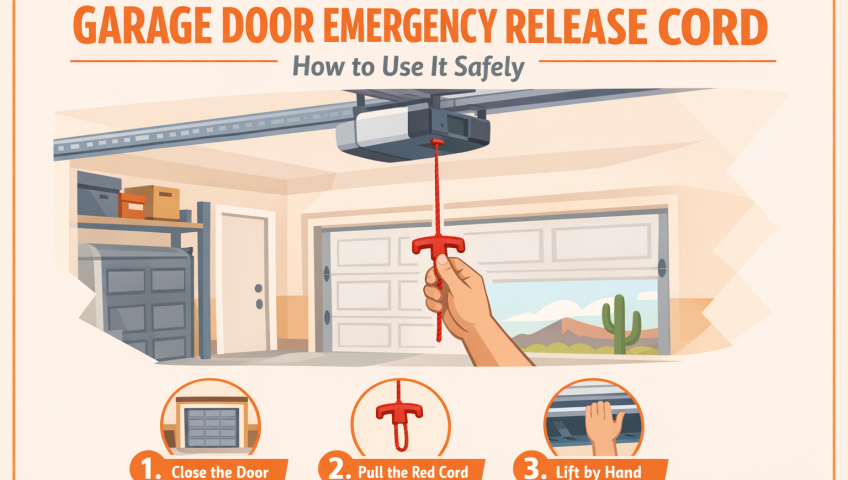
Homeowner pulling the red garage door emergency release cord, with safety steps — CallOrange Garage Door Repair, Tempe AZ

Stuck Inside? How to Use Your Garage Door Emergency Release Cord Safely

The garage door emergency release cord is the bright red rope hanging from your opener’s rail, and it exists for a single purpose: to disconnect the door from the motor so you can raise or lower it by hand when the power is out or the opener quits. Used correctly, it takes seconds. Used at the wrong moment, it can let a heavy door fall.

A summer storm knocks the power out across your Tempe neighborhood, the opener falls silent, and your car is trapped behind a door that won’t budge — with somewhere you need to be. That exact scenario is what the garage door emergency release cord was built for, and pulling it safely is far simpler than most homeowners expect. At CallOrange Garage Door Repair, we’ve coached thousands of Valley households through this moment since 2008. We’ll show you what the red handle actually does, when it’s safe to use, and the one situation where pulling it can cause real harm. If you’d rather have help on the way while you read, you can find our Tempe location on Google Maps.

Garage Door Emergency Release Cord: What It Is and Why Every Door Has One

The garage door emergency release cord is a short rope with a red handle connected to the trolley — the carriage that travels along your opener’s rail and pushes the door up and down. Pulling the handle trips a spring-loaded lever that separates the door’s arm from that trolley, switching the door from powered operation to manual. Once disconnected, the door is no longer held by the motor; it’s held only by its springs, which is exactly why understanding the system before you tug on anything matters.

Every automatic opener sold in the United States — whether it’s a LiftMaster, Chamberlain, or Genie — ships with this release by federal design standard. It’s the same mechanism whether you own a chain-drive unit from the 1990s or a Wi-Fi model wired into your smart home integration. Our factory-trained technicians work with all of them, and the release operates on the same principle across the board.

Where to Find It on Your System

Look up at the rail running from the wall or ceiling motor toward the door. The red handle hangs from a small trolley roughly in the center of that rail. In most homes it dangles six to seven feet off the ground — high enough that it isn’t an everyday object, low enough to reach without a ladder. If you’ve never noticed it, you’re in good company; many of the homeowners who call our garage door service team are surprised it was there all along.

Why Building Codes Require It

The release exists for safety, not convenience. If anyone is ever trapped inside a garage during a fire or power loss, that cord is the manual override that gets the door open. It also protects the opener motor itself — forcing a powered door open or closed can strip the gears and burn out the unit. Knowing how to disengage it cleanly is part of basic home ownership, much like knowing where your water shutoff valve is.

When the Emergency Release Cord Helps — and When to Stop

Situation Safe to Use the Cord? What to Do
Power outage, door looks normal ✓ Yes Release, operate by hand, re-latch when power returns
Opener motor dead, door sits level ✓ Yes Use the cord, then schedule an opener repair
Remote or keypad not responding ✓ Yes Use the cord; check batteries and the opener
Door stuck open, but looks normal ✓ With care Support the door, release, lower it gently
Loud bang, door now crooked or very heavy ✗ No Likely a broken spring — call a professional
Door has come off the track / leaning ✗ No Don’t pull the cord — call a professional
Frayed, loose, or hanging cable ✗ No Stop — cable is under tension; call a pro
Bent panels, hardware, or rollers ✗ No Have it inspected before operating the door

When to Pull the Cord — and the One Time You Shouldn’t

Most of the time, the garage door emergency release cord is exactly the right tool. Reach for it confidently when the power is out, when the opener has died but the door itself looks normal, or when a remote or wall button has failed and you simply need to get the car out. In each of these cases the door is mechanically sound — only the powered drive is offline.

There is, however, one situation that changes everything: a broken torsion spring. Your springs, not the opener, carry the real weight of the door. When a torsion spring snaps — often with a bang loud enough to wake the house — the opener may be the only thing still holding the door up. Pull the release in that moment and the door can drop with enough force to injure anyone beneath it and crack the panels. The same caution applies to a door that has come off its track, a frayed or hanging cable or roller, or visibly bent hardware.

How can you tell? A healthy door sits level, and the springs above it look intact and tightly wound. A door with a snapped spring often hangs crooked, shows a clear gap in the spring coil, or feels impossibly heavy to lift. When anything looks off, leave the cord alone and call our emergency repair team instead.

⚠️ Safety Warning: High-Tension Springs & Electrical Hazards

Garage door torsion springs are wound under extreme tension — enough stored energy to cause severe injury or death if a spring, cable, or winding bar slips. Opener units also connect to 120V AC household wiring. Never attempt to adjust, wind, or replace springs, cables, or opener wiring yourself, and never pull the emergency release on a door you suspect has a broken spring. The U.S. Consumer Product Safety Commission (CPSC) links thousands of garage door injuries each year to spring failures and improper repairs. When in doubt, hire a licensed, insured garage door technician. Every CallOrange technician is licensed, insured, and trained to handle these components safely.

How to Use Your Garage Door Emergency Release Cord Safely, Step by Step

When the door is sound and you’ve ruled out a broken spring, releasing it by hand takes under a minute. Here is the process our technicians teach every customer.

Step 1 — Lower the Door First if You Can

Whenever possible, disconnect the release while the door is fully closed. A closed door rests on the floor, so there’s no stored height for it to fall from and no chance of it dropping. If the power died with the door open, support the door or have a second person help before you pull the handle — and never stand directly beneath a raised door as you release it.

Step 2 — Pull the Red Handle Straight Down

Grip the red handle and pull it straight down in one firm motion. You’ll feel the lever click as the trolley separates from the door arm. Pulling down rather than at an angle keeps the mechanism from binding and makes reconnecting easier later.

Step 3 — Operate the Door by Hand

With the opener disengaged, lift the door using the lift handles or the bottom edge, raising it smoothly to fully open. A properly balanced door will glide and stay where you leave it. If it feels extremely heavy or wants to slam shut, that’s a sign the springs are doing too little — stop, lower it gently, and call a professional. When you’re finished, lower the door fully so your home stays secure.

Step 4 — Reconnect the Opener

Once power returns, re-engage the trolley. On most LiftMaster, Chamberlain, and Genie units you simply pull the red handle back toward the door (or straight down again, depending on the model) until the lever re-locks, then run the opener through one full cycle. The trolley clicks back into the carriage automatically as the door moves. If it won’t re-latch, our opener repair specialists can reset it quickly.

Why Openers and Doors Fail When You Least Expect It

Understanding why you ended up reaching for that cord helps you prevent the next emergency. Across the Phoenix metro, a handful of regional factors put unusual stress on garage systems.

Arizona heat is the first culprit. Attached garages routinely climb past 120°F in summer, which thins factory grease, hardens the nylon on rollers, and bakes the electronics inside the opener’s logic board. Power surges from monsoon storms are the second — a single surge can fry an opener’s circuit board and leave you depending on the manual release until a replacement arrives. The third is simple wear: every torsion spring is rated in cycles, and a busy family opening the door several times a day can exhaust that rating in just a few years.

Brand and age matter, too. A modern LiftMaster with myQ or a Genie running Aladdin Connect behaves differently from a twenty-year-old chain drive, and resetting a connected unit after a manual release sometimes calls for re-syncing the app. Our team works across every major brand daily, which is why we can talk a customer through a smart-opener reset as easily as an older model — and why we cover the full range in our guide to garage door home automation.

None of this is only about getting the car out. A door that opens evenly and seals tightly protects your curb appeal, reinforces your home security by latching reliably every night, and — paired with insulated panels — helps your garage hold temperature against the desert heat. The release cord is your backup; a well-maintained door is what keeps you from needing it.

Preventing the Next Garage Door Lockout

The best way to handle a manual release is to rarely need one. A few practical upgrades dramatically cut the odds of getting stuck again.

The biggest one is a battery backup opener. Many newer LiftMaster and Chamberlain models include an integrated backup battery that keeps the door working through a power outage — the exact scenario that sends most homeowners hunting for the red cord. If your opener is more than a decade old, our opener installation team can tell you whether a backup-equipped upgrade makes sense for your home.

A quality surge protector on the garage circuit is a smart, low-cost second layer, especially heading into monsoon season when lightning-driven surges take out opener boards across the Valley. And nothing beats a routine inspection: a yearly garage door tune-up catches the worn spring, fraying cable, or tired opener gear before it strands you. We keep maintenance histories for our regular clients so we can replace parts on a schedule that suits you — not on the door’s worst possible day. You’ll find more seasonal guidance on our blog.

Manual Operation vs. Calling a Professional: Making the Right Call

There’s a clear line between what’s safe to handle yourself and what calls for a trained, insured technician. Releasing a sound door, operating it by hand, and reconnecting the opener are well within any homeowner’s ability. Diagnosing why the door failed — and anything involving springs, cables, or electrical components — is not.

The reason is simple: torsion springs store enormous energy and are responsible for the most serious garage door injuries in the country every year. The same goes for cables under load and 120V opener wiring. Our certified technicians carry the tools, training, and insurance to handle those components safely, and we’d always rather you call than risk it. The table below shows where that line falls.

Safe to Do Yourself vs. Best Left to CallOrange

Task Safe to DIY? Best Left to a Pro
Pulling the release on a sound door ✓ Yes
Operating a balanced door by hand ✓ Yes
Reconnecting the opener trolley ✓ Usually We’ll reset it if it won’t latch
Diagnosing why the opener failed Limited ✓ Full diagnostic
Adjusting or replacing torsion springs ✗ Never ✓ Licensed, insured techs
Repairing or replacing cables ✗ Never ✓ Pro only
Opener circuit board or wiring repair ✗ Never ✓ Pro only
Realigning a door that’s off track ✗ Never ✓ Pro only
Annual safety & balance inspection Limited ✓ Recommended yearly

If you’re ever unsure which side of that line you’re on, the safest move is a quick call to our service team. We offer 24/7 emergency dispatch across Tempe and the greater Phoenix area, and you can always reach us through our contact page or stop by our shop on Google Maps.

Frequently Asked Questions — Garage Door Emergency Release Cord

What does the garage door emergency release cord do?

The red release cord disconnects your door from the opener’s trolley so you can raise or lower it by hand. It’s designed for power outages or opener failures, letting you operate the door manually until the opener is working again.

Is it safe to pull the release cord while the door is open?

Only with care. A raised door can fall once it’s disconnected from the opener, so support it or have a second person help, and never stand directly beneath it. Whenever possible, release the door while it’s fully closed. If you’re unsure, our Tempe team can talk you through it.

Why shouldn’t I use the release cord if a spring is broken?

Your torsion springs carry the door’s weight. If a spring snaps, the opener may be the only thing holding the door up — pulling the release then can let it crash down. If the door is crooked, extremely heavy, or you heard a loud bang, leave the cord alone and call a professional.

How do I reconnect my opener after using the release?

Once power returns, pull the red handle back toward the door (or straight down again, depending on the model) until the lever re-locks, then run the opener through one cycle. The trolley re-latches automatically as the door moves. If it won’t reconnect, our opener specialists can reset it the same day.

Will the emergency release work during a power outage?

Yes — that’s exactly what it’s for. The release is purely mechanical and needs no electricity. Many newer LiftMaster and Chamberlain openers also include a battery backup that keeps the door powered through an outage. Ask our service team whether a backup-equipped opener is right for your home.

My release cord is stuck or won’t reconnect — what now?

Don’t force it. A stuck release can point to a bent trolley, a worn lever, or a deeper mechanical issue. Our technicians can inspect and reset it safely — book a visit or find us on Google Maps.

Keep Your Family Moving When the Power Cuts Out

A dead opener doesn’t have to mean a trapped car or a missed morning. Knowing how your garage door emergency release cord works — and, just as importantly, knowing the one time not to touch it — turns a stressful surprise into a thirty-second fix. The red handle is a remarkably well-engineered safety feature, and a little familiarity with it is one of the most useful things you can know about the largest moving part of your home. For the bigger picture on keeping that system dependable year-round, our breakdown of what happens during a professional garage door tune-up is a natural next read.

At CallOrange Garage Door Repair, every service call is handled by background-checked, factory-trained technicians who work on LiftMaster, Chamberlain, and Genie systems throughout Tempe. Whether you need a fast opener repair, a torsion spring replacement, or just a second opinion on whether that cord is safe to pull, we’re a phone call away. Call us at (480) 690-3344, seven days a week from 7 AM to 11 PM, with 24/7 emergency dispatch. You can schedule service online in under a minute, or visit our Tempe location on Google Maps at 2101 E Broadway Rd, Suite 3. When the power cuts out, we’ll make sure your door — and your family — keeps moving.
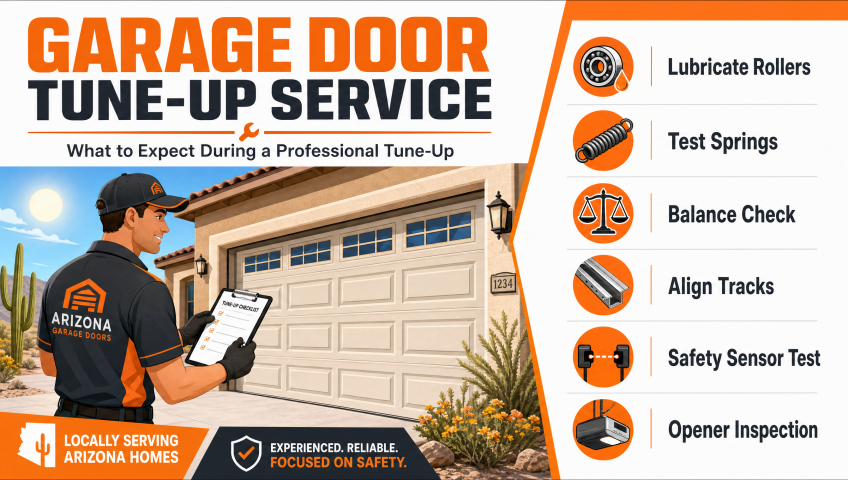
Professional garage door tune-up service checklist banner by CallOrange in Tempe, AZ

Garage Door Tune-Up Service: What to Expect During a Professional Tune-Up

The door groans halfway up, jerks, then thuds against the floor a little harder than it used to. You tell yourself you’ll deal with it later — until the morning it stops halfway and won’t budge with the car already running. That slow decline almost never fixes itself, but it is highly preventable. A scheduled garage door tune-up service catches the small problems while they are still small, and below we walk you through exactly what a professional visit looks like so you know precisely what you’re paying for.

At CallOrange Garage Door Repair, we’ve serviced thousands of doors across the Valley since 2008, and the pattern is remarkably consistent: the doors that get a regular tune-up rarely become the emergency calls. We want to show you why that is, what our technicians actually do during a visit, and how to tell when your own door is overdue. You can also find our Tempe location on Google Maps if you’d like to confirm our service area before reading on.

What a Garage Door Tune-Up Service Actually Includes

A professional garage door tune-up service is a structured, multi-point inspection and adjustment of every moving and load-bearing component of your door system — not a quick spray of lubricant and a wave goodbye. The goal is to restore the door to factory-smooth operation, correct the wear that has crept in since the last visit, and flag any part that is approaching the end of its service life before it fails.

A complete tune-up covers four interconnected systems that all have to work together: the counterbalance system (springs, cables, and drums), the guidance system (rollers, hinges, and tracks), the drive system (the opener motor, rail, and logic board), and the safety system (photo-eye sensors and auto-reverse). When any one of these drifts out of specification, it quietly overloads the others. A door with a fatigued spring, for example, forces the opener to lift more weight than it was rated for, which shortens the motor’s life and strains the rail.

Our team treats every visit as a diagnostic appointment first and an adjustment second. We’ve published a full breakdown of our professional garage door services so you can see how a routine tune-up connects to repairs like torsion spring replacement or track realignment when they’re needed.

The Core Checklist

Every CallOrange tune-up follows the same baseline checklist before any door-specific work begins:

  • Balance test — disconnecting the opener and lifting the door by hand to confirm the springs are carrying the weight correctly.
  • Spring and cable inspection — checking torsion springs for fatigue, rust, and gaps, and cables for fraying.
  • Roller and hinge check — examining rollers for flat spots, cracked nylon, or worn bearings.
  • Track alignment — verifying tracks are plumb, level, and free of dents.
  • Hardware tightening — torquing every bolt, bracket, and lag screw that vibration has loosened.
  • Lubrication — applying the correct lubricant to springs, rollers, hinges, and the opener rail.
  • Opener and safety test — running the opener through a full cycle and testing the auto-reverse and photo-eyes.

What a Professional Tune-Up Covers — and Why It Matters

Tune-Up Step What We Do Why It Protects You
Balance Test Disconnect opener & lift door by hand Confirms springs carry the weight, not your motor
Spring & Cable Check Inspect torsion springs and cables for wear Prevents sudden, dangerous spring failure
Roller & Hinge Inspection Examine for flat spots, cracks, worn bearings Stops grinding and binding before it spreads
Track Alignment Verify tracks are plumb, level, and dent-free Keeps the door from jamming or coming off track
Hardware Tightening Re-torque every bolt, bracket, and lag screw Reverses the loosening caused by daily vibration
Lubrication Apply correct lubricant to all moving parts Restores quiet operation; fights Arizona heat & dust
Opener Calibration Reset travel limits and force settings Door seals fully and stops at the right points
Safety System Test Test auto-reverse and photo-eye sensors Ensures the door reverses for people, pets, and cars
Panel & Weather Seal Check Inspect panels and bottom seal condition Protects curb appeal, security, and energy efficiency

Why Garage Doors Drift Out of Tune

Understanding why a door declines helps you see why preventive service pays for itself. A residential garage door is the largest and heaviest moving object in most homes, and in the Phoenix metro it operates under conditions that accelerate wear far beyond the national average.

The Cycle Count Problem

Garage door springs are rated in cycles — one cycle equals one full open and one full close. A standard torsion spring is rated for roughly 10,000 cycles. That sounds like a lot until you count real usage: a busy family opening and closing the door four to six times a day will burn through that rating in four to seven years. Once a spring passes its cycle life, it doesn’t fail politely — it snaps, often with a bang loud enough to be mistaken for a gunshot, and the door becomes dangerously heavy in an instant.

Arizona Heat, Dust, and Thermal Cycling

Tempe summers are punishing on garage hardware. Daytime temperatures inside an attached garage routinely climb past 120°F, and that heat thins out factory grease, bakes the nylon on rollers, and expands and contracts metal components every single day. Fine desert dust then settles into the dried-out bearings and tracks, acting like a grinding paste. This combination is exactly why our roller replacement and track service requests spike every summer. Regular lubrication during a tune-up is the single most effective defense against this regional wear pattern.

Vibration and Settling

Every cycle sends a small shudder through the door’s hardware. Over hundreds of cycles, that vibration backs out lag screws, loosens hinge bolts, and lets brackets shift. A loose track bracket lets the track drift out of alignment, which makes the rollers bind, which makes the opener work harder — a cascade that starts with a single quarter-turn of play in one bolt. Catching and re-torquing that hardware is routine during a tune-up and prevents the cascade entirely.

Why DIY Often Misses the Real Problem

Homeowners frequently lubricate the noisy parts and consider the job done, but noise is a symptom, not the cause. The grinding sound may be coming from a roller, but the reason the roller is failing might be a track that’s a sixteenth of an inch out of plumb, or a spring that’s no longer balancing the load. Diagnosing the root cause is what separates a professional garage door tune-up service from a weekend spray-down. Our certified technicians are trained to trace symptoms back to their source.

⚠️ Safety Warning: High-Tension Springs & Electrical Hazards

Garage door torsion springs are wound under extreme tension — enough stored energy to cause severe injury or death if a spring, cable, or winding bar slips during adjustment. Opener units also connect to 120V AC household wiring. Never attempt to adjust, wind, or replace springs, cables, or opener wiring yourself. The U.S. Consumer Product Safety Commission (CPSC) links thousands of garage door injuries each year to spring failures and improper repairs. Always hire a licensed, insured garage door technician for spring, cable, or electrical work. Every CallOrange technician is licensed, insured, and trained to handle these components safely.

Our Step-by-Step Professional Tune-Up Process

When you book a tune-up with our team, here is exactly what happens from the moment we arrive. Transparency is part of how we work — you’re welcome to watch every step.

Step 1 — Visual and Operational Assessment

We begin by running the door through a normal cycle while it’s still connected to the opener, listening and watching for hesitation, grinding, jerking, or uneven movement. This shows us how the system behaves under power before we start isolating components.

Step 2 — Manual Balance Test

We disconnect the opener using the emergency release and lift the door by hand to roughly waist height. A properly balanced door will hold its position; a door that slams down or shoots up is telling us the torsion springs are out of adjustment or losing tension. This test is the heart of any honest tune-up.

Step 3 — Hardware and Component Inspection

We inspect the springs, cables, drums, rollers, hinges, brackets, and tracks one by one. We also check the door panels themselves for cracks, separation, or stress fractures that can signal a deeper structural issue and may call for panel replacement.

Step 4 — Adjustment and Tightening

We re-torque all hardware to specification, adjust the track alignment, fine-tune spring tension when it’s within safe limits, and reset the opener’s travel and force settings so the door stops and seals correctly at both ends of its travel.

Step 5 — Lubrication

We apply a lithium-based or silicone lubricant — never WD-40, which is a solvent that strips grease rather than providing it — to the springs, bearings, rollers, hinges, and opener rail. This is what restores that quiet, smooth glide.

Step 6 — Safety System Verification

Finally, we test the federally mandated safety features: the auto-reverse mechanism (the door must reverse when it contacts an object) and the photo-eye sensors near the floor. A tune-up that skips this step isn’t complete. If your opener is older than the 1993 safety standard, we’ll tell you honestly and explain your options.

Professional Tune-Up vs. DIY Maintenance

There’s real value in homeowner maintenance, and we encourage it — keeping tracks clear and listening for new noises genuinely helps. But there’s a clear line between what’s safe to do yourself and what requires a trained, insured technician with the right tools.

Light maintenance you can safely handle includes wiping down the tracks, visually checking the cables for obvious fraying, testing the auto-reverse by laying a block of wood in the door’s path, and lubricating the rollers and hinges with a proper garage door lubricant. What you should never attempt is adjusting or replacing torsion springs, repairing cables, or modifying the spring tension — these components store enormous mechanical energy and are responsible for the most severe garage door injuries every year.

Brand matters here, too. Modern openers from LiftMaster, Chamberlain, and Genie each have proprietary force-adjustment procedures, travel-limit settings, and diagnostic codes. A LiftMaster with myQ connectivity, for instance, behaves differently from an older chain-drive Genie, and resetting the limits incorrectly can leave the door failing to close or reversing for no reason. Our technicians work across all major brands daily, which is why we can tune a modern smart opener as confidently as a twenty-year-old unit. If you’ve been weighing a newer connected model, our guide to garage door home automation explains how smart home integration ties into opener maintenance.

A professional garage door tune-up service also protects more than the mechanics. A door that opens evenly and seals tightly supports your home’s curb appeal, reinforces your home security by closing and latching reliably every time, and — with a properly weather-sealed door — helps your garage hold temperature, which matters more if you’ve invested in insulated garage doors.

How Often Should You Schedule a Tune-Up?

For most Tempe households, we recommend a professional tune-up once a year. Homes with heavy daily use — multiple drivers, a door that doubles as the main entry, or a household running several cycles a day — benefit from a twice-yearly schedule, ideally once before the brutal summer heat sets in and once after.

Beyond the calendar, your door will tell you when it needs attention. Schedule a visit promptly if you notice any of the following: the door has become noticeably louder, it moves unevenly or jerks during travel, it sags or hangs crooked when partway open, the opener struggles or strains, or you hear a loud bang from the garage (a classic sign of a snapped spring). Any of these is worth a call to our service team rather than a wait-and-see approach.

A consistent maintenance rhythm is also the cheapest insurance you can buy for the system. The cost of an annual tune-up is a small fraction of an emergency spring or panel repair, and a far smaller fraction than replacing an opener motor that burned out lifting an unbalanced door. We keep maintenance histories for our regular clients so we can predict component wear and replace parts on your schedule, not on the door’s worst possible day. You’ll find more seasonal care tips on our blog.

Frequently Asked Questions — Garage Door Tune-Up Service

How long does a professional garage door tune-up take?

A standard residential tune-up takes about 45 minutes to an hour for a single door. If our technician finds a component that needs repair — such as a worn torsion spring or a damaged roller — we’ll explain the issue and the cost before doing any extra work. The inspection and adjustment themselves are quick; we never rush the safety tests.

How often should I schedule a garage door tune-up service in Tempe?

Once a year is right for most homes. Households with heavy daily use should consider twice a year — once before summer and once after — because Arizona heat and dust accelerate wear on rollers, bearings, and lubricant. If your door has gotten louder or rougher, don’t wait for the schedule; book a visit sooner.

Can I do a garage door tune-up myself?

You can safely handle light maintenance — wiping tracks, lubricating rollers and hinges, and testing the auto-reverse with a block of wood. What you should never attempt is adjusting or replacing torsion springs, repairing cables, or modifying spring tension. Those components store enormous energy and cause the most serious garage door injuries each year. Leave them to a trained, insured technician.

What are the warning signs my garage door needs a tune-up?

Watch for increased noise, jerky or uneven movement, the door sagging when partway open, the opener straining, or a loud bang from the garage (often a snapped spring). Any of these means it’s time to call our service team for an inspection before a small issue becomes an emergency.

Does a tune-up work on smart openers like LiftMaster myQ?

Yes. Our technicians service all major brands — LiftMaster, Chamberlain, and Genie — including modern Wi-Fi connected models. A tune-up on a smart opener also includes verifying travel limits and force settings so the unit reports door status correctly. If you’re interested in upgrading, our guide to garage door home automation covers smart home integration in detail.

Is a garage door tune-up worth the cost?

Almost always. The cost of an annual tune-up is a small fraction of an emergency spring repair or a burned-out opener motor, and it extends the life of every component on the door. Preventive service is the cheapest insurance you can buy for the heaviest moving part of your home. Find us on Google Maps or call to schedule.

Keep the Heaviest Door in Your Home Working Like New

A garage door is easy to take for granted right up until the morning it traps your car inside — and almost every one of those mornings was preventable. A regular garage door tune-up service is the quiet, unglamorous habit that keeps the largest moving part of your home safe, quiet, and dependable through Arizona’s hardest seasons. It protects your home security, preserves your curb appeal, and spares you the cost and stress of an emergency repair on the worst possible day.

At CallOrange Garage Door Repair, every tune-up is performed by background-checked, factory-trained technicians who service LiftMaster, Chamberlain, and Genie systems across Tempe and the greater Phoenix area. We bring the same care to a routine maintenance visit as we do to a full torsion spring replacement or panel repair — because we’d rather catch the small problem today than rescue you from the big one next month.

If your door has been louder, slower, or rougher than it used to be, don’t wait for it to quit. Call us at (480) 690-3344, available Monday through Sunday, 7 AM to 11 PM, with 24/7 emergency dispatch. You can schedule your tune-up online in under a minute, or visit our Tempe service location on Google Maps at 2101 E Broadway Rd, Suite 3, to see where we’re based. Your garage door does heavy work every single day — let our team keep it running like the day it was installed.

Insulated vs. Non-Insulated Garage Doors: The Real Difference

Every garage door decision comes down to one fundamental question: are you paying for a panel that keeps things out, or one that actively works for your home? Most homeowners in Tempe replace a garage door once every fifteen to twenty years, so when the moment arrives, it carries real weight. You can drive through any neighborhood off Broadway Road or Warner Drive and see two kinds of doors sitting side by side — one that feels solid when you tap it, and one that rings hollow. That difference is not cosmetic. It determines how your garage handles 115°F summer heat, how much noise bleeds through into your living space, how well your panels survive monsoon season, and what the upgrade ultimately does to your home’s value at resale.

At CallOrange Garage Door Repair, we have been helping Tempe, Mesa, and Phoenix homeowners make this exact decision since 2008. The answer is almost never as simple as “pick the cheaper one.” This guide breaks down how these two door types are built, where each performs best, and which choice delivers the strongest long-term return for your specific situation.

What Are Insulated Garage Doors? A Real Comparison for Arizona Homeowners

Insulated garage doors are constructed with one or more layers of insulating material — polystyrene or polyurethane foam — built directly into the door panel. This gives the door thermal resistance, structural rigidity, and acoustic dampening that a hollow steel panel simply cannot match.

A non-insulated garage door, also called a single-layer door, consists of a single sheet of embossed steel with nothing behind it. It is the lightest and lowest-cost option at the point of purchase. It also has legitimate applications. But it performs very differently under real-world conditions — particularly the conditions that define life in the Phoenix Metro.

Single-Layer, Double-Layer, and Triple-Layer Construction

Not all insulated doors are built the same way, and understanding the construction tiers is the foundation of a smart purchase decision:

  • Single-layer (non-insulated): One sheet of embossed steel, typically 24-gauge or 25-gauge. No fill. Lightweight but prone to denting and a poor thermal barrier. Resonates audibly with wind and mechanical vibration.
  • Double-layer (polystyrene board): A steel outer skin with rigid polystyrene foam glued or pressed to the inside. Better insulation than single-layer, but not fully sealed — air infiltration can bypass the foam at the perimeter and fold lines.
  • Triple-layer (injected polyurethane): Two steel skins with polyurethane foam injected into the cavity and cured in place. The foam chemically bonds to both skins, forming a single rigid structural unit. This is the current industry standard for high-performance residential doors from brands like Clopay, Amarr, and Wayne Dalton.

When our team at CallOrange performs a new garage door installation, we walk through these tiers with each homeowner before a single bolt is touched. The right construction depends on your garage’s relationship to your living space, how you use the garage, and your long-term goals for the home.

The R-Value Scale and Why It Matters in Arizona

R-value measures thermal resistance — how effectively a material slows the transfer of heat. Higher is better. For garage doors, R-values range from R-0 on a true single-layer door up to R-32 on premium triple-layer polyurethane models.

In Phoenix Metro summers, interior garage temperatures in a non-insulated garage routinely exceed 130°F by mid-afternoon. A door rated R-13 to R-18 can reduce that interior temperature by 20 to 30 degrees. If your garage shares a wall with a bedroom, home office, laundry room, or any conditioned living area, that thermal resistance translates directly into reduced HVAC runtime and lower electric bills.

Insulated vs. Non-Insulated Garage Doors — Side-by-Side Comparison

Feature Single-Layer (Non-Insulated) Double-Layer (Polystyrene) Triple-Layer (Polyurethane)
Construction 1 steel skin, no fill Steel + polystyrene board 2 steel skins + injected foam
R-Value R-0 R-6 to R-9 R-12 to R-32
Noise Reduction Minimal Moderate Excellent
Structural Rigidity Low Moderate High
Arizona Summer Performance Poor — conducts heat freely Fair Excellent
Estimated Lifespan (AZ) 12–15 years 18–22 years 25–30 years
Installed Cost (16×7, Tempe) $700–$950 $900–$1,250 $1,200–$1,900+
Energy Savings Potential None Moderate Significant
Design / Style Options Limited Moderate Full range
Smart Home Compatible Yes Yes Yes
Best For Detached / storage garages Budget-conscious upgrade Primary attached garage

Arizona’s Climate Makes Insulation More Than a Comfort Upgrade

In most U.S. markets, garage door insulation is discussed in terms of winter heating. In Tempe, the math flips entirely. The dominant energy load here is cooling, and the garage door is typically one of the largest uninsulated surfaces in the entire home — often 9 feet wide by 7 or 8 feet tall, facing west or south in thousands of Tempe properties.

Summer Heat and Your Monthly Energy Bill

A non-insulated steel door absorbs solar radiation through the day and re-radiates that heat into the garage interior well into the evening. Any conditioned space sharing a wall with the garage — a bedroom, bonus room, or home gym — fights that heat load constantly. Your AC runs longer. Your bill climbs.

A triple-layer door with polyurethane insulation significantly reduces this thermal transfer. Homeowners we’ve served along the Kyrene corridor and in South Mountain communities have reported measurable reductions in summer cooling costs after upgrading from single-layer to roll-up insulated doors. The savings compound over a door’s 25-to-30-year lifespan.

Protecting What You Store — and What You’ve Built

Beyond energy costs, sustained heat above 120°F degrades nearly everything stored in a non-insulated garage: motor oil thickens, latex paint separates, rubber goods crack and harden, electronics degrade, and water heaters or softeners tucked near the door wall age faster. A workshop, gym, or storage-heavy garage amplifies every one of these effects.

This is why CallOrange Garage Door Repair recommends insulated doors for any homeowner using the garage for more than pure vehicle storage. Our garage door repair services include full door assessments so you can understand exactly what your current setup is costing you before you commit to a replacement.

⚠️ Safety Warning: High-Tension Springs & Door Weight

Insulated garage doors — particularly triple-layer polyurethane models — are significantly heavier than single-layer doors. A standard 16×7 insulated door can weigh 150–200 lbs or more. Never attempt to remove, install, or adjust a garage door or its hardware without professional training. The torsion springs that counterbalance the door’s weight store hundreds of pounds of mechanical tension. A spring that releases unexpectedly can cause severe injury or death. The U.S. Consumer Product Safety Commission (CPSC) records thousands of garage door-related injuries annually — the majority involving spring failures and improper DIY work. Switching from a non-insulated to an insulated door also requires recalibrating or replacing the existing springs and verifying your opener’s lift capacity. Always hire a licensed, insured garage door technician. Our team at CallOrange is fully licensed, insured, background-checked, and performs these transitions safely every day.

Noise Reduction, Durability, and Curb Appeal

Energy performance is the headlining argument for insulation in Arizona, but three additional benefits frequently become the deciding factor in our consultations.

The Structural Advantage of Polyurethane Foam

A triple-layer door with injected polyurethane foam is measurably stiffer and more impact-resistant than any single-layer door of equivalent steel gauge. The foam acts as a continuous internal brace, distributing load evenly across the full panel surface rather than concentrating stress at fold lines and hinge attachment points. In practice, this means:

  • Panels resist monsoon wind pressure and debris impacts more effectively
  • Accidental vehicle contact causes shallower, smaller dents
  • The door retains flatness over time, reducing track binding and wear on rollers

Our technicians who handle garage door panel repair see significantly fewer stress fractures and premature hinge failures on triple-layer doors compared to single-layer units of similar age. Structural rigidity also reduces the cyclical flex that fatigues springs — a meaningful benefit given what a broken spring repair costs in time and money.

A Quieter Home Starts at the Door

A hollow steel door resonates like a drum. Wind rattles it, the opener vibrates it, and every cycle sends a wave of mechanical noise through the structure. A polyurethane-filled triple-layer door effectively deadens that resonance through mass and internal damping — reducing both operational noise and exterior sound infiltration.

This matters significantly in Tempe neighborhoods near Loop 202, the Price Freeway, or light rail corridors. If you’re also considering a quieter garage door opener installation — a belt-drive LiftMaster or a direct-drive Chamberlain — pairing it with a triple-layer insulated door delivers the full noise-reduction benefit. A belt-drive opener against a resonating single-skin door will still be noticeably louder than a chain-drive paired with a properly insulated triple-layer panel.

Curb Appeal, Home Security, and Smart Home Integration

Premium carriage-house styles, wood-look composites, and custom overlay designs are manufactured almost exclusively as insulated models, because the rigid foam core is what structurally supports the overlay elements. An insulated door gives you full access to the design range that drives genuine curb appeal improvements.

From a home security standpoint, a thicker, stiffer door panel is harder to force or compromise physically. Paired with garage door home automation via LiftMaster myQ, Chamberlain’s app, or Genie Aladdin Connect, you gain remote monitoring and real-time alerts that make unauthorized access visible instantly. The combination of structural integrity and smart home integration converts your garage from a passive entry point into an actively monitored one.

When a Non-Insulated Garage Door Still Makes Sense

We believe in straight talk, and there are genuine situations where a non-insulated door is the right recommendation:

  • Fully detached garages with no adjacent conditioned space: If heat transfer to your living area is not a factor and you’re not using the garage as a workspace, the energy argument weakens considerably.
  • Low-use storage garages: A garage accessed a few times a month has less thermal transfer volume and less acoustic noise to manage.
  • Short-term occupancy or investment properties: The lower upfront cost may serve the investment model if you’re not the long-term owner.
  • Immediate budget constraints with a plan to upgrade: Sometimes the most practical answer is the most affordable functional door while you plan a proper replacement. Our team handles garage door repair near me calls every day and always recommends the solution that fits your actual situation — not the most expensive one.

Even in these cases, we’d typically recommend a double-layer polystyrene door over a true single-skin, because the durability difference at a modest price premium is almost always worth it in Arizona’s conditions.

Cost vs. Value — Making the Right Long-Term Decision

The upfront price difference between door types depends on size, style, and manufacturer. For a standard 16×7 double-car residential door with professional installation in the Phoenix Metro:

  • Single-layer non-insulated: Typically $700–$950 installed
  • Double-layer polystyrene: Typically $900–$1,250 installed
  • Triple-layer polyurethane: Typically $1,200–$1,900+ installed

These are ranges — actual cost depends on gauge, design, and hardware selections. Every installation we perform at CallOrange includes a written estimate before any work begins.

The calculation most homeowners underestimate is the long-term cost differential. A quality triple-layer insulated door in Arizona typically lasts 25–30 years with proper garage door maintenance. A builder-grade single-layer door in the Phoenix climate may need panel replacement or full replacement within 12–15 years due to heat-cycling damage to steel, hardware, and weatherstripping. If you’re already asking whether your door needs professional repair or full replacement, the insulated replacement almost always pencils out.

Remodeling Magazine’s annual Cost vs. Value Report consistently ranks garage door replacement among the top-three projects nationally for return on investment. At resale, an upgraded insulated door frequently returns more than 90 cents on every dollar spent.

For any mechanical issues discovered during your evaluation — worn garage door springs, misaligned tracks, or fraying cables — our team addresses each component as part of a full-service visit so nothing gets left behind.

Frequently Asked Questions — Insulated Garage Doors

What R-value should I look for in a garage door for Tempe, AZ?

For an attached garage in Tempe that shares a wall with conditioned living space, we recommend a minimum of R-13. A triple-layer polyurethane door in the R-16 to R-18 range offers a practical sweet spot of performance and cost for most residential applications. If you run a workshop or gym in the garage, a higher R-value reduces the load on any supplemental cooling you add. Our team can recommend specific models during a free on-site assessment — contact CallOrange to schedule.

Are insulated garage doors worth the extra cost in Arizona?

For most Tempe homeowners with an attached garage, yes — clearly. The combination of reduced cooling costs, extended door lifespan (25–30 years vs. 12–15 for single-layer), lower noise, and a higher resale contribution consistently makes insulated doors the better financial decision over the door’s full life. The premium over a single-layer door typically ranges from $400 to $900 installed. In Arizona’s climate, that gap pays back faster than in moderate-climate states. Explore our full garage door services for details.

Can I add insulation to my existing non-insulated garage door?

Yes — retrofit insulation kits using polystyrene or reflective foam panels are available and can raise an existing door’s R-value from R-0 to approximately R-4 to R-6. This is a short-term improvement, not a permanent solution. Retrofit insulation adds weight without recalibrating your springs, which accelerates spring wear and can void opener warranties. If your door is more than 10 years old, a full door replacement is usually the more cost-effective path. Our technicians are happy to assess whether a retrofit or full replacement makes more sense for your setup.

Do insulated garage doors require different springs or openers?

Yes — and this is one of the most important details homeowners miss when comparing door types. An insulated triple-layer door is significantly heavier than a single-layer door of the same dimensions. Existing torsion springs must be recalculated and often replaced to match the new door weight. Your opener’s motor must also meet the door’s lift requirements — undersized openers burn out quickly against a heavier door. At CallOrange, every door replacement includes a full mechanical assessment so the springs, cables, and opener are properly matched to the new door.

How long do insulated garage doors last in Arizona’s climate?

A quality triple-layer polyurethane door with regular maintenance typically lasts 25–30 years in the Phoenix Metro. The polyurethane foam resists the heat-cycling that causes single-layer panels to warp and the steel to fatigue at fold lines. The biggest longevity factors are annual garage door maintenance — lubrication, hardware tightening, weatherstrip inspection — and addressing small issues before they become structural ones.

Will an insulated garage door actually lower my energy bill?

It depends on your home’s configuration. If your garage is attached and shares at least one wall with conditioned living space, insulation provides a meaningful thermal barrier that reduces heat transfer into that space, lowering AC runtime. The savings are most dramatic in west- or south-facing garages with direct afternoon sun exposure — common in Tempe subdivisions. If your garage is fully detached with no adjacent conditioned rooms, the energy benefit is minimal. Reach out to CallOrange for a free consultation.

The Door That Works Hardest for Your Home

For the overwhelming majority of Tempe homeowners, an insulated garage door — specifically a triple-layer polyurethane unit — is the clear long-term choice. It outperforms a single-layer door on every measurable dimension: thermal efficiency, structural rigidity, acoustic performance, and resale contribution. In a climate where your door faces 115°F summers, sustained UV exposure, and relentless monsoon dust and wind, build quality matters more than it does almost anywhere else in the country.

A non-insulated door is not a wrong choice in the right circumstances. But if your garage shares walls with conditioned living space, if you use it daily, or if you plan to remain in the home for the next decade or more, the math consistently and convincingly favors insulation.

CallOrange Garage Door Repair has been making this assessment for Tempe homeowners since 2008. Our licensed, insured technicians provide written estimates with no obligation, and we offer same-day service across Tempe, Mesa, Chandler, Scottsdale, and the broader Phoenix Metro. Explore our complete range of garage door services or call us directly at (480) 690-3344 — a real dispatcher answers from 7 a.m. to 11 p.m. every day of the week.

You can also find us and read verified customer reviews on Google Maps to see exactly what our Tempe neighbors say about the upgrade. Once your new insulated door is in place, our guide to garage door home automation covers the natural next step — connecting your door to Alexa, Google Home, or Apple HomeKit for real-time visibility and hands-free control from anywhere.