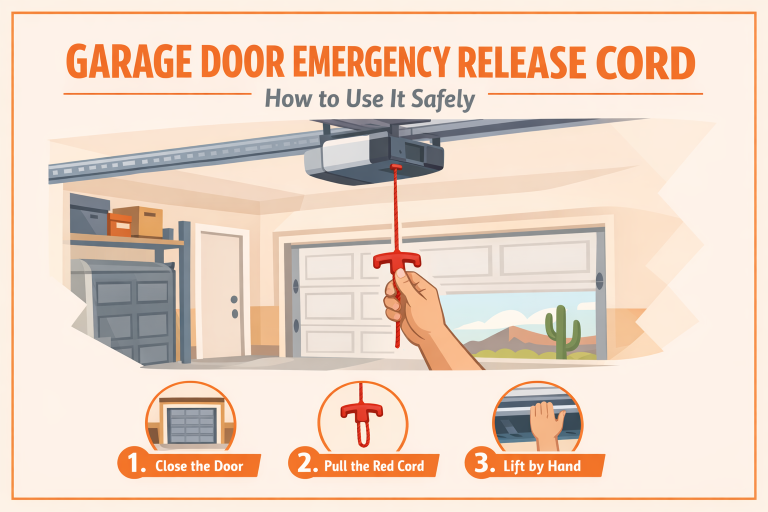
Homeowner pulling the red garage door emergency release cord, with safety steps — CallOrange Garage Door Repair, Tempe AZ

Stuck Inside? How to Use Your Garage Door Emergency Release Cord Safely

The garage door emergency release cord is the bright red rope hanging from your opener’s rail, and it exists for a single purpose: to disconnect the door from the motor so you can raise or lower it by hand when the power is out or the opener quits. Used correctly, it takes seconds. Used at the wrong moment, it can let a heavy door fall.

A summer storm knocks the power out across your Tempe neighborhood, the opener falls silent, and your car is trapped behind a door that won’t budge — with somewhere you need to be. That exact scenario is what the garage door emergency release cord was built for, and pulling it safely is far simpler than most homeowners expect. At CallOrange Garage Door Repair, we’ve coached thousands of Valley households through this moment since 2008. We’ll show you what the red handle actually does, when it’s safe to use, and the one situation where pulling it can cause real harm. If you’d rather have help on the way while you read, you can find our Tempe location on Google Maps.

Garage Door Emergency Release Cord: What It Is and Why Every Door Has One

The garage door emergency release cord is a short rope with a red handle connected to the trolley — the carriage that travels along your opener’s rail and pushes the door up and down. Pulling the handle trips a spring-loaded lever that separates the door’s arm from that trolley, switching the door from powered operation to manual. Once disconnected, the door is no longer held by the motor; it’s held only by its springs, which is exactly why understanding the system before you tug on anything matters.

Every automatic opener sold in the United States — whether it’s a LiftMaster, Chamberlain, or Genie — ships with this release by federal design standard. It’s the same mechanism whether you own a chain-drive unit from the 1990s or a Wi-Fi model wired into your smart home integration. Our factory-trained technicians work with all of them, and the release operates on the same principle across the board.

Where to Find It on Your System

Look up at the rail running from the wall or ceiling motor toward the door. The red handle hangs from a small trolley roughly in the center of that rail. In most homes it dangles six to seven feet off the ground — high enough that it isn’t an everyday object, low enough to reach without a ladder. If you’ve never noticed it, you’re in good company; many of the homeowners who call our garage door service team are surprised it was there all along.

Why Building Codes Require It

The release exists for safety, not convenience. If anyone is ever trapped inside a garage during a fire or power loss, that cord is the manual override that gets the door open. It also protects the opener motor itself — forcing a powered door open or closed can strip the gears and burn out the unit. Knowing how to disengage it cleanly is part of basic home ownership, much like knowing where your water shutoff valve is.

When the Emergency Release Cord Helps — and When to Stop

Situation Safe to Use the Cord? What to Do
Power outage, door looks normal ✓ Yes Release, operate by hand, re-latch when power returns
Opener motor dead, door sits level ✓ Yes Use the cord, then schedule an opener repair
Remote or keypad not responding ✓ Yes Use the cord; check batteries and the opener
Door stuck open, but looks normal ✓ With care Support the door, release, lower it gently
Loud bang, door now crooked or very heavy ✗ No Likely a broken spring — call a professional
Door has come off the track / leaning ✗ No Don’t pull the cord — call a professional
Frayed, loose, or hanging cable ✗ No Stop — cable is under tension; call a pro
Bent panels, hardware, or rollers ✗ No Have it inspected before operating the door

When to Pull the Cord — and the One Time You Shouldn’t

Most of the time, the garage door emergency release cord is exactly the right tool. Reach for it confidently when the power is out, when the opener has died but the door itself looks normal, or when a remote or wall button has failed and you simply need to get the car out. In each of these cases the door is mechanically sound — only the powered drive is offline.

There is, however, one situation that changes everything: a broken torsion spring. Your springs, not the opener, carry the real weight of the door. When a torsion spring snaps — often with a bang loud enough to wake the house — the opener may be the only thing still holding the door up. Pull the release in that moment and the door can drop with enough force to injure anyone beneath it and crack the panels. The same caution applies to a door that has come off its track, a frayed or hanging cable or roller, or visibly bent hardware.

How can you tell? A healthy door sits level, and the springs above it look intact and tightly wound. A door with a snapped spring often hangs crooked, shows a clear gap in the spring coil, or feels impossibly heavy to lift. When anything looks off, leave the cord alone and call our emergency repair team instead.

⚠️ Safety Warning: High-Tension Springs & Electrical Hazards

Garage door torsion springs are wound under extreme tension — enough stored energy to cause severe injury or death if a spring, cable, or winding bar slips. Opener units also connect to 120V AC household wiring. Never attempt to adjust, wind, or replace springs, cables, or opener wiring yourself, and never pull the emergency release on a door you suspect has a broken spring. The U.S. Consumer Product Safety Commission (CPSC) links thousands of garage door injuries each year to spring failures and improper repairs. When in doubt, hire a licensed, insured garage door technician. Every CallOrange technician is licensed, insured, and trained to handle these components safely.

How to Use Your Garage Door Emergency Release Cord Safely, Step by Step

When the door is sound and you’ve ruled out a broken spring, releasing it by hand takes under a minute. Here is the process our technicians teach every customer.

Step 1 — Lower the Door First if You Can

Whenever possible, disconnect the release while the door is fully closed. A closed door rests on the floor, so there’s no stored height for it to fall from and no chance of it dropping. If the power died with the door open, support the door or have a second person help before you pull the handle — and never stand directly beneath a raised door as you release it.

Step 2 — Pull the Red Handle Straight Down

Grip the red handle and pull it straight down in one firm motion. You’ll feel the lever click as the trolley separates from the door arm. Pulling down rather than at an angle keeps the mechanism from binding and makes reconnecting easier later.

Step 3 — Operate the Door by Hand

With the opener disengaged, lift the door using the lift handles or the bottom edge, raising it smoothly to fully open. A properly balanced door will glide and stay where you leave it. If it feels extremely heavy or wants to slam shut, that’s a sign the springs are doing too little — stop, lower it gently, and call a professional. When you’re finished, lower the door fully so your home stays secure.

Step 4 — Reconnect the Opener

Once power returns, re-engage the trolley. On most LiftMaster, Chamberlain, and Genie units you simply pull the red handle back toward the door (or straight down again, depending on the model) until the lever re-locks, then run the opener through one full cycle. The trolley clicks back into the carriage automatically as the door moves. If it won’t re-latch, our opener repair specialists can reset it quickly.

Why Openers and Doors Fail When You Least Expect It

Understanding why you ended up reaching for that cord helps you prevent the next emergency. Across the Phoenix metro, a handful of regional factors put unusual stress on garage systems.

Arizona heat is the first culprit. Attached garages routinely climb past 120°F in summer, which thins factory grease, hardens the nylon on rollers, and bakes the electronics inside the opener’s logic board. Power surges from monsoon storms are the second — a single surge can fry an opener’s circuit board and leave you depending on the manual release until a replacement arrives. The third is simple wear: every torsion spring is rated in cycles, and a busy family opening the door several times a day can exhaust that rating in just a few years.

Brand and age matter, too. A modern LiftMaster with myQ or a Genie running Aladdin Connect behaves differently from a twenty-year-old chain drive, and resetting a connected unit after a manual release sometimes calls for re-syncing the app. Our team works across every major brand daily, which is why we can talk a customer through a smart-opener reset as easily as an older model — and why we cover the full range in our guide to garage door home automation.

None of this is only about getting the car out. A door that opens evenly and seals tightly protects your curb appeal, reinforces your home security by latching reliably every night, and — paired with insulated panels — helps your garage hold temperature against the desert heat. The release cord is your backup; a well-maintained door is what keeps you from needing it.

Preventing the Next Garage Door Lockout

The best way to handle a manual release is to rarely need one. A few practical upgrades dramatically cut the odds of getting stuck again.

The biggest one is a battery backup opener. Many newer LiftMaster and Chamberlain models include an integrated backup battery that keeps the door working through a power outage — the exact scenario that sends most homeowners hunting for the red cord. If your opener is more than a decade old, our opener installation team can tell you whether a backup-equipped upgrade makes sense for your home.

A quality surge protector on the garage circuit is a smart, low-cost second layer, especially heading into monsoon season when lightning-driven surges take out opener boards across the Valley. And nothing beats a routine inspection: a yearly garage door tune-up catches the worn spring, fraying cable, or tired opener gear before it strands you. We keep maintenance histories for our regular clients so we can replace parts on a schedule that suits you — not on the door’s worst possible day. You’ll find more seasonal guidance on our blog.

Manual Operation vs. Calling a Professional: Making the Right Call

There’s a clear line between what’s safe to handle yourself and what calls for a trained, insured technician. Releasing a sound door, operating it by hand, and reconnecting the opener are well within any homeowner’s ability. Diagnosing why the door failed — and anything involving springs, cables, or electrical components — is not.

The reason is simple: torsion springs store enormous energy and are responsible for the most serious garage door injuries in the country every year. The same goes for cables under load and 120V opener wiring. Our certified technicians carry the tools, training, and insurance to handle those components safely, and we’d always rather you call than risk it. The table below shows where that line falls.

Safe to Do Yourself vs. Best Left to CallOrange

Task Safe to DIY? Best Left to a Pro
Pulling the release on a sound door ✓ Yes
Operating a balanced door by hand ✓ Yes
Reconnecting the opener trolley ✓ Usually We’ll reset it if it won’t latch
Diagnosing why the opener failed Limited ✓ Full diagnostic
Adjusting or replacing torsion springs ✗ Never ✓ Licensed, insured techs
Repairing or replacing cables ✗ Never ✓ Pro only
Opener circuit board or wiring repair ✗ Never ✓ Pro only
Realigning a door that’s off track ✗ Never ✓ Pro only
Annual safety & balance inspection Limited ✓ Recommended yearly

If you’re ever unsure which side of that line you’re on, the safest move is a quick call to our service team. We offer 24/7 emergency dispatch across Tempe and the greater Phoenix area, and you can always reach us through our contact page or stop by our shop on Google Maps.

Frequently Asked Questions — Garage Door Emergency Release Cord

What does the garage door emergency release cord do?

The red release cord disconnects your door from the opener’s trolley so you can raise or lower it by hand. It’s designed for power outages or opener failures, letting you operate the door manually until the opener is working again.

Is it safe to pull the release cord while the door is open?

Only with care. A raised door can fall once it’s disconnected from the opener, so support it or have a second person help, and never stand directly beneath it. Whenever possible, release the door while it’s fully closed. If you’re unsure, our Tempe team can talk you through it.

Why shouldn’t I use the release cord if a spring is broken?

Your torsion springs carry the door’s weight. If a spring snaps, the opener may be the only thing holding the door up — pulling the release then can let it crash down. If the door is crooked, extremely heavy, or you heard a loud bang, leave the cord alone and call a professional.

How do I reconnect my opener after using the release?

Once power returns, pull the red handle back toward the door (or straight down again, depending on the model) until the lever re-locks, then run the opener through one cycle. The trolley re-latches automatically as the door moves. If it won’t reconnect, our opener specialists can reset it the same day.

Will the emergency release work during a power outage?

Yes — that’s exactly what it’s for. The release is purely mechanical and needs no electricity. Many newer LiftMaster and Chamberlain openers also include a battery backup that keeps the door powered through an outage. Ask our service team whether a backup-equipped opener is right for your home.

My release cord is stuck or won’t reconnect — what now?

Don’t force it. A stuck release can point to a bent trolley, a worn lever, or a deeper mechanical issue. Our technicians can inspect and reset it safely — book a visit or find us on Google Maps.

Keep Your Family Moving When the Power Cuts Out

A dead opener doesn’t have to mean a trapped car or a missed morning. Knowing how your garage door emergency release cord works — and, just as importantly, knowing the one time not to touch it — turns a stressful surprise into a thirty-second fix. The red handle is a remarkably well-engineered safety feature, and a little familiarity with it is one of the most useful things you can know about the largest moving part of your home. For the bigger picture on keeping that system dependable year-round, our breakdown of what happens during a professional garage door tune-up is a natural next read.

At CallOrange Garage Door Repair, every service call is handled by background-checked, factory-trained technicians who work on LiftMaster, Chamberlain, and Genie systems throughout Tempe. Whether you need a fast opener repair, a torsion spring replacement, or just a second opinion on whether that cord is safe to pull, we’re a phone call away. Call us at (480) 690-3344, seven days a week from 7 AM to 11 PM, with 24/7 emergency dispatch. You can schedule service online in under a minute, or visit our Tempe location on Google Maps at 2101 E Broadway Rd, Suite 3. When the power cuts out, we’ll make sure your door — and your family — keeps moving.

garage door installation

Garage Door Installation: What to Expect from a Professional Service

Installing a new garage door is one of the most important upgrades you can make to your home. It improves curb appeal, enhances security, increases energy efficiency, and ensures reliable daily operation. But many homeowners in Mesa, Phoenix, Tempe, and Scottsdale are unsure what the professional installation process actually involves.

Is it completed in one day?
What components are replaced?
How do you know you’re hiring the right company?

In this complete guide, we explain exactly what to expect from a professional garage door installation and why working with experienced technicians like Call Orange Garage Repair makes all the difference.

For full service details, visit:
https://callorange-garage-repair.com/

Why Professional Garage Door Installation Matters

A garage door is not just a panel that opens and closes. It is a system made up of:

  • Tracks

  • Rollers

  • Torsion springs

  • Hinges

  • Cables

  • Panels

  • Opener motor

  • Safety sensors

Improper installation can lead to:

  • Premature torsion spring replacement

  • Garage door track repair issues

  • Uneven movement

  • Opener strain

  • Safety risks

Professional installation ensures the entire system is properly aligned, balanced, and secured.

Step 1: Initial Consultation & Inspection

Before installation begins, a professional technician evaluates:

  • Garage opening dimensions

  • Headroom and side clearance

  • Existing track condition

  • Opener compatibility

  • Insulation needs

In Arizona cities like Phoenix and Scottsdale, heat resistance and insulation are especially important.

If older components are worn, the technician may recommend:

  • Garage door track alignment

  • Garage door roller replacement

  • Garage door spring repair

This ensures your new system operates smoothly from day one.

Step 2: Removal of the Old Door (If Applicable)

If replacing an existing unit, professionals will safely remove:

  • Panels

  • Torsion springs

  • Tracks

  • Rollers

  • Cables

Old spring systems require careful handling due to high tension. This is why torsion spring replacement should never be a DIY task.

Learn more about spring services here:
https://callorange-garage-repair.com/services/torsion-spring/

Step 3: Installation of Tracks & Hardware

The new system begins with precise installation of vertical and horizontal tracks. Proper garage door track alignment is critical.

Incorrect alignment can cause:

  • Shaking

  • Grinding

  • Off-track movement

  • Premature wear

Professional garage door track repair and installation ensure smooth motion and balanced operation.

Track services are available here:
https://callorange-garage-repair.com/services/track-services/

Step 4: Panel Assembly & Secure Mounting

New panels are carefully assembled and secured section by section.

High-quality garage door panel replacement and installation ensure:

  • Proper weight distribution

  • Strong structural support

  • Weather resistance

  • Improved insulation

Panel services can be reviewed here:
https://callorange-garage-repair.com/services/panel-replacement/

Step 5: Spring System Installation

The torsion spring system is the heart of your garage door.

During installation:

  • Springs are calibrated to door weight

  • Proper tension is applied

  • Balance is tested manually

If improperly installed, you may soon require garage door spring repair or experience unsafe operation.

Professionally balanced springs reduce strain on the opener and extend system lifespan.

Step 6: Roller & Cable Installation

New rollers are installed to ensure smooth, quiet movement.

Upgrading to premium nylon rollers significantly reduces noise—especially important in attached garages in Tempe and Mesa homes.

Professional garage door roller replacement ensures long-term durability.

Roller services available here:
https://callorange-garage-repair.com/services/roller-replacement/

Step 7: Garage Door Opener Installation & Testing

If replacing or installing a new opener, technicians will:

  • Mount the motor unit

  • Install safety sensors

  • Connect wall controls

  • Program remotes

  • Test force settings

Modern garage door opener installation provides:

  • Quiet belt-drive systems

  • Smart WiFi access

  • Battery backup

  • Enhanced safety features

Learn about opener services here:
https://callorange-garage-repair.com/services/garage-door-opener-installation/

Step 8: Full Safety Inspection & Performance Testing

After installation, professionals conduct a complete garage door inspection, checking:

  • Balance

  • Auto-reverse function

  • Sensor alignment

  • Track smoothness

  • Spring tension

  • Cable security

This ensures safe and reliable operation.

Regular garage door maintenance after installation keeps the system operating efficiently for years.

How Long Does Professional Installation Take?

In most residential cases:

  • Standard installation: 3–6 hours

  • Complex replacements: Same-day completion

Call Orange Garage Repair offers same day garage door service across Mesa, Phoenix, Tempe, and Scottsdale whenever possible.

Signs You Need a New Garage Door Installation

You may need professional installation if:

  • Frequent garage door track repair is required

  • Multiple torsion spring replacement cycles have occurred

  • Panels are severely damaged

  • Opener fails repeatedly

  • The door is over 15–20 years old

If unsure, schedule an inspection here:
https://callorange-garage-repair.com/contact-us/

Benefits of Professional Installation

Homeowners choosing professional garage door installation gain:

Increased Security

Stronger locking mechanisms and durable panels.

Better Energy Efficiency

Improved insulation reduces Arizona heat intrusion.

Reduced Noise

Proper garage door roller replacement and track alignment eliminate vibration.

Longer Lifespan

Balanced torsion springs reduce system stress.

Lower Long-Term Costs

Avoid recurring emergency garage door repair.

Why Homeowners Trust Call Orange Garage Repair

Across Mesa, Phoenix, Tempe, and Scottsdale, homeowners choose Call Orange Garage Repair for:

  • Skilled residential technicians

  • Transparent pricing

  • Affordable garage door repair options

  • Same day garage door service

  • Emergency garage door repair availability

  • High-quality installation materials

Learn more about their commitment to excellence here:
https://callorange-garage-repair.com/about-us/

Invest in Professional Garage Door Installation for Long-Term Reliability

A garage door installation is not just a cosmetic upgrade—it is a safety, security, and performance investment. From precise garage door track alignment to proper torsion spring calibration and professional garage door opener installation, every step must be executed correctly.

Attempting shortcuts or hiring inexperienced installers can result in ongoing garage door spring repair, misalignment issues, noisy rollers, or emergency breakdowns.

Homeowners in Mesa, Phoenix, Tempe, Scottsdale, and surrounding Arizona communities deserve a garage door system that operates smoothly, safely, and reliably every day.

If you’re planning a new garage door installation or replacing an aging system, trust the experienced professionals at Call Orange Garage Repair.

Schedule your professional installation today:
https://callorange-garage-repair.com/contact-us/

Upgrade your home. Improve safety. Enhance curb appeal. And enjoy peace of mind with expert garage door installation done right the first time.

garage door needs professional repair

How to Know When Your Garage Door Needs Professional Repair

Warning Signs Every Homeowner in Mesa, Phoenix, Tempe & Scottsdale Should Recognize

Your garage door is one of the hardest-working systems in your home. It opens and closes multiple times a day, protects your vehicles, secures your belongings, and acts as a major entry point to your house. Yet most homeowners in Mesa, Phoenix, Tempe, and Scottsdale rarely think about it—until something goes wrong.

The problem is that garage doors rarely fail without warning. They give subtle signs first: strange noises, slower movement, minor shaking, or cosmetic damage. Ignoring these signs can lead to expensive repairs, safety hazards, and emergency breakdowns at the worst possible time.

In this comprehensive guide, we’ll explain exactly how to know when your garage door needs professional repair, what warning signs to look for, and why calling a trusted local expert like Call Orange Garage Repair can prevent bigger problems.

For complete residential garage door solutions, visit:
https://callorange-garage-repair.com/

Why Garage Door Problems Should Never Be Ignored

A garage door system includes multiple high-tension and moving components:

  • Torsion springs

  • Cables

  • Rollers

  • Tracks

  • Panels

  • Hinges

  • Opener motor

  • Safety sensors

When one component fails, it puts stress on the entire system. What begins as a small issue—like worn rollers—can eventually lead to spring failure or track damage.

In Arizona’s climate, extreme heat accelerates wear on metal components and rubber seals. That’s why regular garage door inspection and maintenance are especially important in cities like Phoenix and Scottsdale.

1. Unusual or Loud Noises During Operation

One of the earliest warning signs that your garage door needs professional repair is excessive noise.

A properly functioning door should operate smoothly with minimal sound. If you begin to hear:

  • Grinding

  • Squealing

  • Popping

  • Scraping

  • Loud banging

There is likely an underlying mechanical issue.

What These Noises Often Mean

  • Grinding: Roller wear or track damage

  • Squealing: Lack of lubrication or metal friction

  • Loud snap: Possible torsion spring break

  • Scraping: Garage door track alignment issues

Ignoring these sounds can lead to more serious structural damage. Worn rollers, for example, can eventually cause track bending and door imbalance.

Professional garage door roller replacement restores smooth and quiet movement. Learn more here:
https://callorange-garage-repair.com/services/roller-replacement/

2. The Door Moves Unevenly or Jerks While Operating

Does your garage door shake, wobble, or move unevenly?

This is a strong indication of:

  • Garage door track misalignment

  • Bent rails

  • Spring imbalance

  • Cable tension issues

When tracks are not aligned properly, the door cannot distribute weight evenly. This puts added strain on torsion springs and opener motors.

Professional garage door track repair ensures proper alignment and prevents dangerous off-track situations.

Explore track services here:
https://callorange-garage-repair.com/services/track-services/

3. The Door Feels Heavy or Won’t Open Fully

If your garage door suddenly feels heavier than usual when lifting manually, it’s likely a spring problem.

Torsion springs are responsible for counterbalancing the door’s weight. When a spring breaks, the full weight of the door transfers to the opener—or to you.

Signs of Torsion Spring Failure

  • Loud snapping sound

  • Door lifts only a few inches

  • Visible gap in the torsion spring

  • Opener struggling or stopping midway

Torsion spring replacement should only be handled by trained professionals. Springs are under extreme tension and can cause serious injury if mishandled.

Call Orange Garage Repair provides safe and efficient garage door spring repair services across Mesa, Phoenix, Tempe, and Scottsdale.

Learn more here:
https://callorange-garage-repair.com/services/torsion-spring/

4. Visible Damage to Garage Door Panels

Dented or cracked panels may seem cosmetic—but they can affect structural balance and system performance.

Common causes include:

  • Accidental vehicle impact

  • Weather exposure

  • Age-related warping

  • Heat expansion

Damaged panels can create uneven weight distribution, leading to premature spring and track wear.

Professional garage door panel replacement restores both appearance and structural integrity.

See panel replacement services here:
https://callorange-garage-repair.com/services/panel-replacement/

5. The Garage Door Opener Is Malfunctioning

Your garage door opener is the brain of the system. When it starts to fail, you may notice:

  • Delayed response

  • Remote or keypad failure

  • Door reversing unexpectedly

  • Motor running but door not moving

  • Flashing sensor lights

Sometimes a garage door opener repair resolves the issue. In other cases, modern garage door opener installation is the smarter long-term investment—especially if your unit is over 10–15 years old.

Upgrading to a newer opener provides:

  • Quieter operation

  • Enhanced safety sensors

  • Smart home compatibility

  • Battery backup features

Learn about opener installation and repair here:
https://callorange-garage-repair.com/services/garage-door-opener-installation/

6. The Door Comes Off Track

An off-track garage door is a serious emergency.

This usually occurs due to:

  • Track misalignment

  • Broken cables

  • Roller failure

  • Impact damage

If your door is off its rails, do not attempt to force it closed. This can worsen the damage and create safety risks.

Emergency garage door repair services are available for urgent situations. Same day garage door service ensures your home remains secure.

Request immediate assistance here:
https://callorange-garage-repair.com/contact-us/

7. Increased Energy Bills or Poor Insulation

In Arizona, garages can become extremely hot. Damaged panels, poor sealing, or misaligned doors allow outside heat to enter.

This increases cooling strain on your home and raises energy costs.

Regular garage door maintenance and inspection help detect insulation issues early.

8. Slow or Hesitant Operation

A garage door that hesitates before moving may indicate:

  • Motor wear

  • Track friction

  • Roller deterioration

  • Spring imbalance

Slow operation often precedes total system failure. Addressing the issue early prevents emergency repairs.

Affordable garage door repair is always less expensive when handled before complete breakdown.

The Value of Professional Garage Door Inspection

Many homeowners wait until something breaks. But proactive garage door inspection prevents emergencies.

A professional inspection typically includes:

  • Spring tension evaluation

  • Track alignment check

  • Roller condition assessment

  • Cable integrity inspection

  • Opener diagnostic testing

  • Hardware tightening

Routine garage door maintenance extends system lifespan and reduces long-term costs.

Why Professional Repair Is Always the Safer Choice

DIY repairs might seem cost-effective, but garage door systems involve high-tension components that can be dangerous.

Professional technicians provide:

  • Proper tools

  • Correct safety procedures

  • Accurate diagnostics

  • High-quality replacement parts

  • Long-lasting repairs

Call Orange Garage Repair is known across Mesa, Phoenix, Tempe, and Scottsdale for skilled technicians and reliable solutions.

Learn more about their experience here:
https://callorange-garage-repair.com/about-us/

Why Homeowners Trust Call Orange Garage Repair

Choosing the right company matters.

Call Orange Garage Repair offers:

  • Same day garage door service

  • Emergency garage door repair

  • Transparent pricing

  • Skilled residential technicians

  • Quality replacement components

  • Fast response throughout the Valley

Their team understands how Arizona heat impacts springs, rollers, and tracks—delivering solutions designed for long-term durability.

When to Call Immediately

Contact a professional right away if:

  • A torsion spring breaks

  • The door is off track

  • The opener stops working completely

  • The door won’t close securely

  • You hear a loud snapping sound

  • The door becomes extremely heavy

Waiting increases risk and repair costs.

Don’t Wait for a Complete Breakdown

Your garage door will almost always warn you before a major failure. Unusual noises, uneven movement, damaged panels, slow operation, or opener issues are not minor inconveniences—they are early signs that professional repair is needed.

Addressing problems early protects your home, improves safety, and prevents costly emergency repairs. Whether you need garage door track alignment, torsion spring replacement, garage door roller replacement, opener repair, panel replacement, or full garage door maintenance, acting quickly is always the smart choice.

Homeowners in Mesa, Phoenix, Tempe, Scottsdale, and surrounding Arizona communities trust Call Orange Garage Repair for fast, affordable, and professional service.

Don’t ignore the warning signs.

Schedule your garage door inspection or repair today:
https://callorange-garage-repair.com/contact-us/

Protect your home. Restore performance. And ensure your garage door operates safely and reliably with expert service from Call Orange Garage Repair.