
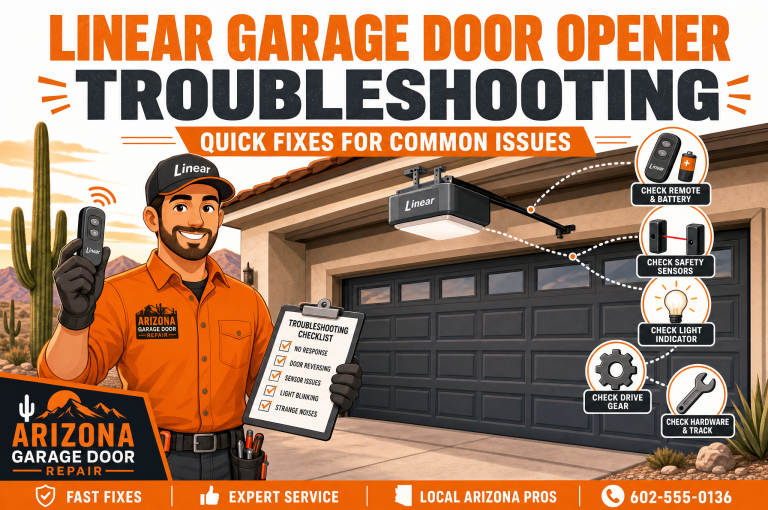
Linear garage door opener troubleshooting infographic with technician, remote, safety sensors and quick fixes in Tempe AZ

Linear Garage Door Opener Troubleshooting: Quick Fixes for Common Issues

Linear garage door opener troubleshooting usually comes down to three quick checks: confirm the unit has power, make sure the safety sensors are aligned and free of dust, and test the remote batteries before assuming the motor has failed. In our experience handling garage door opener issues across the Valley since 2008, most Linear problems are fixable in under an hour. We put this guide together from real service calls completed by our certified technicians near our Tempe location, so you can solve the simple faults yourself and know exactly when to call us.

Why Won’t My Linear Garage Door Opener Respond?

When a Linear opener goes completely silent, we always start with the power supply. It sounds obvious, but a surprising number of the service calls we run for CallOrange Garage Door Repair end with a tripped GFCI outlet or a breaker that flipped during one of our Arizona monsoon storms. Plug a phone charger into the same outlet the opener uses. If the charger doesn’t light up, reset the outlet or the breaker and test the wall button again.

If the outlet has power but the opener stays dead, unplug the unit for two full minutes and plug it back in. Linear models like the LDCO800 and LDO50 have logic boards that occasionally lock up after a power surge, and this simple reset clears the fault more often than you’d expect. Still nothing? The board or transformer may have failed — something we diagnose daily alongside other common garage door problems in Tempe homes.

Here’s the quick-reference chart our technicians share with homeowners:

Symptom Most Likely Cause Quick Fix
No response at all Tripped GFCI outlet or breaker Reset outlet/breaker; unplug unit 2 minutes
Remote works, wall button doesn’t Loose or damaged wall-station wiring Check the two low-voltage wires at both ends
Wall button works, remote doesn’t Dead battery or lost programming Replace battery; re-learn remote to opener
Door reverses before closing Blocked or misaligned safety sensors Clean lenses; realign until LEDs glow steady
Motor hums, door doesn’t move Disengaged trolley or stripped drive gear Re-engage release; call us if gear is stripped
Door opens partially, stops Travel limits or broken spring Adjust limits; inspect springs — do not force
Opener beeps repeatedly Battery backup low or disconnected Replace backup battery (typical life 2–3 years)
Lights flash, door won’t close Sensor circuit fault Check sensor wiring for staple damage or corrosion

Linear Remote and Keypad Problems We Fix Every Week

Linear openers use MegaCode radio technology, which is reliable but has its quirks. If your remote suddenly stops working while the wall button still operates the door, start with a fresh battery — heat inside a parked car in Tempe drains coin cells faster than almost anywhere else in the country.

How to Re-Program a Linear Remote

If a new battery doesn’t help, the remote may have lost its programming. Press the SMART or LEARN button on the opener’s motor head, then press the remote button within 30 seconds. The opener light flashes to confirm the code is stored. Wireless keypads pair the same way: enter your PIN, press ENTER, and press the learn button on the head unit. We walk customers through this on the phone all the time, and it’s the same process we use when we install new units through our garage door opener installation service.

Weak Range and Interference

If the remote only works from a few feet away, check that the thin antenna wire hangs straight down from the motor head. LED shop lights and some smart-home hubs can also interfere with the signal — a detail worth knowing if you’ve been adding devices from our guide to garage door home automation. Owners switching from other brands sometimes ask us whether their old accessories will pair; the answer depends on the radio format, which is why we also service Chamberlain garage door openers and can cross-check compatibility when you contact our team.

Safety Sensor Issues: The Number One Culprit in Arizona

Roughly a third of the Linear opener calls we run turn out to be safety sensor problems. The two photo-eyes mounted about six inches off the floor must see each other at all times. When the beam breaks or the sensors fall out of alignment, the door refuses to close and the opener lights flash — a built-in safety standard we fully support, because it protects kids and pets.

Our Three-Step Sensor Check

First, wipe both lenses with a soft dry cloth. Valley dust storms coat sensor lenses with a film that scatters the infrared beam. Second, check the LED on each sensor: on most Linear models one should glow steady and the other should glow when aligned — if either flickers or is dark, gently bend the bracket until the light holds steady. Third, inspect the wire runs for staples that have cut the insulation, a defect we find often during routine garage door maintenance visits.

Direct sunlight is the sneaky one. During certain months, the low afternoon sun in Phoenix-area garages shines straight into a west-facing sensor and blinds it. If your door only misbehaves at the same time each day, that’s the tell — a small sun shield solves it permanently.

Motor Runs but the Door Doesn’t Move

Hearing the motor hum while the door sits still is unsettling, but the diagnosis is usually simple. Check the emergency release cord first. If someone pulled the red handle, the trolley is disconnected from the carriage; run the opener through one full cycle and it should snap back in, or pull the cord toward the door to re-engage it manually.

If the trolley is engaged and the motor still spins without moving the door, the internal drive gear has likely stripped — a known wear item on older units. That’s a repair we handle in a single visit with parts stocked on our trucks.

Warning: It Might Not Be the Opener at All

Before you blame the Linear unit, pull the release cord and lift the door by hand. If it feels extremely heavy or won’t budge, the problem is a broken torsion spring, not the opener. A snapped spring is the most dangerous fault a garage door can have, and we urge homeowners not to keep pressing the button, because forcing a door with a failed garage door spring burns out the opener motor and can snap the cables. Our team performs broken spring repair and garage door cable repair across the East Valley daily, with professionally rated torsion spring replacement backed by warranty.

Reading Linear Opener Lights, Beeps, and Travel Settings

Linear builds useful diagnostics into its openers. Repeated beeping from the motor head usually means the battery backup is depleted — these batteries last two to three years in our climate, and the opener still runs on AC power while it beeps. A light that flashes when you try to close the door points back to the safety sensor circuit covered above.

Travel limits and force settings matter too. If your door slams the floor and reverses, or stops shy of closing, the down-limit needs a small adjustment using the dials or buttons on the motor head — turn in small increments and test between each change. Force settings that are too high mask real mechanical problems, which is why we always check tracks and rollers before touching the force dial. A door that binds from worn rollers or a bent track makes the opener work harder than it should, and knowing when your garage door needs professional repair can save the motor entirely.

When to Call Our Tempe Technicians

We believe in honest guidance: try the fixes above first, because many of them cost nothing. But some jobs belong to trained hands. Call us for anything involving springs, cables, a stripped drive gear, a dead logic board, or a door that has come off its track. Our technicians are background-checked, factory-trained on Linear, Chamberlain, LiftMaster, and Genie systems, and follow strict safety procedures on every job — standards we’ve refined since 2008.

Homeowners searching for garage door repair near me in Tempe, Mesa, Chandler, or Scottsdale reach us fast because we dispatch locally from Broadway Road. We service every brand and every configuration, from single-car residential doors to commercial garage doors, and our full list of garage door services covers everything from sensors to complete panel replacement. Same-day appointments are available most days of the week, and our reviews reflect the transparent, upfront pricing we quote before any work begins.

Frequently Asked Questions About Linear Openers

Why is my Linear garage door opener not responding to anything?

Check the outlet with another device first, then reset the GFCI or breaker. If power is confirmed, unplug the opener for two minutes to reset the logic board. If it’s still dead, the circuit board or transformer likely failed and needs professional diagnosis.

How do I reset a Linear garage door opener?

Unplug the unit for two minutes and plug it back in. To erase all remotes, hold the SMART/LEARN button until the indicator light goes out, then re-program each remote by pressing the learn button followed by the remote button within 30 seconds.

Why does my Linear opener light keep flashing?

A flashing light when the door refuses to close almost always means the safety sensors are blocked, dirty, or misaligned. Clean both lenses and adjust the brackets until each sensor LED glows steady, then test the door again.

Why is my Linear garage door opener beeping?

Repeated beeping means the battery backup is low, dead, or disconnected. The opener still works on household power. Replacement batteries typically last two to three years in Arizona heat, and swapping one takes about five minutes.

The motor runs but my door doesn’t move. Is the opener broken?

Not necessarily. First re-engage the emergency release trolley. If the motor spins with the trolley engaged, the drive gear has stripped. If the door is also very heavy to lift by hand, you likely have a broken spring — stop using the opener and call a technician.

Is it worth repairing an old Linear opener or should I replace it?

If the unit is under 10 years old, repairs like sensors, remotes, or a drive gear usually make sense. For older openers without modern safety features or battery backup, a new installation often costs little more than a major repair and adds smart-home control.

Get Your Linear Opener Fixed Right the First Time

Linear garage door opener troubleshooting doesn’t have to eat up your weekend — and if you’ve worked through these steps and the door still misbehaves, the fault is almost certainly mechanical or electronic, and that’s exactly what we do best. If you’re weighing repair against an upgrade, our article on what to expect during garage door installation breaks down the process, and you’ll find more owner guides on our blog.

Call CallOrange Garage Door Repair at (480) 690-3344 for fast, same-day Linear opener service anywhere in Tempe and the East Valley. Stop by or check out our local listing on Google Maps to read what your neighbors say about us — then let our certified technicians get your door running smoothly again today.