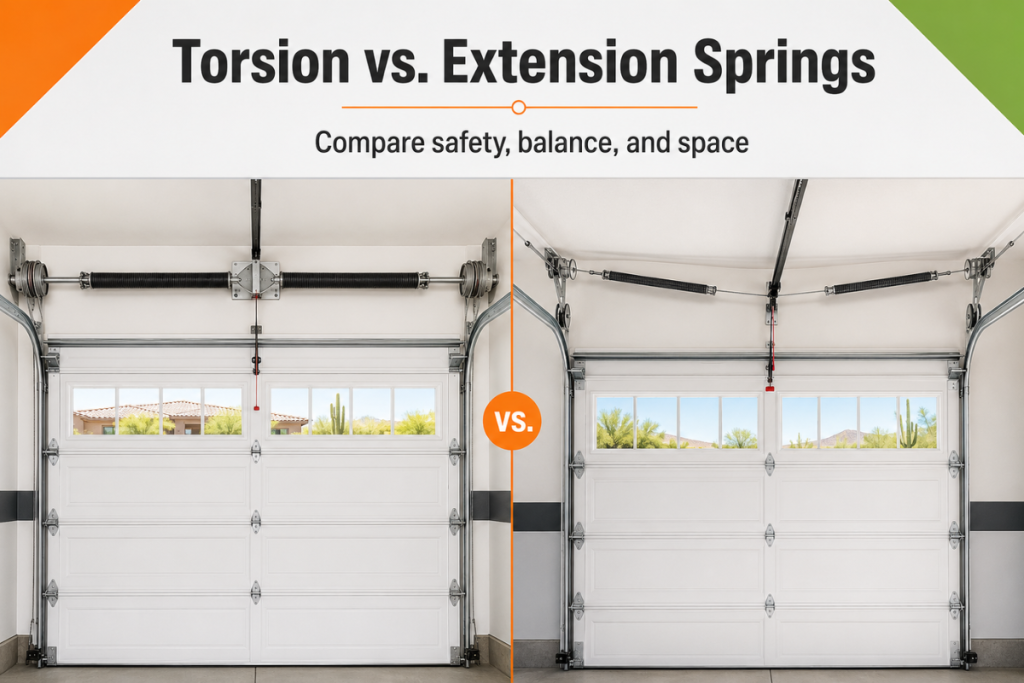
Torsion vs extension springs is mainly a comparison of how two systems counterbalance a garage door. Torsion springs rotate on a shaft above the opening, while extension springs stretch beside the horizontal tracks. Both store significant energy, but torsion systems generally provide better containment, smoother balance and more controlled movement when correctly specified and installed.
How Do Garage Door Spring Systems Work?
| Comparison point | Torsion springs | Extension springs |
|---|---|---|
| Location | On a shaft above the door opening | Along both horizontal tracks |
| Movement | Coils wind and unwind | Coils stretch and contract |
| Door balance | Torque is distributed through the shaft and cable drums | Separate springs pull from both sides |
| Containment | A broken spring generally remains on the shaft | Requires a correctly installed safety cable through each spring |
| Space needed | Adequate header space and secure center support | Clear space beside the horizontal tracks |
| Typical decision | Often preferred for control and modern residential installations | May remain suitable when correctly installed and contained |
Springs do not lift a door independently. They form part of a counterbalance system that offsets most of the door’s weight so the door can move in a controlled way and the opener does not carry the full load. A properly matched system should allow smooth, level movement through the full travel path.
How torsion springs apply force
A torsion spring is mounted around a steel shaft above the door. As the door closes, lift cables wrap and the spring winds, storing energy. When the door opens, the spring unwinds and rotates the shaft and cable drums to help raise the door evenly.
How extension springs apply force
Extension springs usually run above or beside the horizontal tracks. They stretch when the door closes and contract as it opens. Pulleys and cables transfer that force to the door. Because each side has its own spring and cable path, wear or mismatch on one side can contribute to uneven movement.
What Are the Key Differences Between Torsion and Extension Springs?
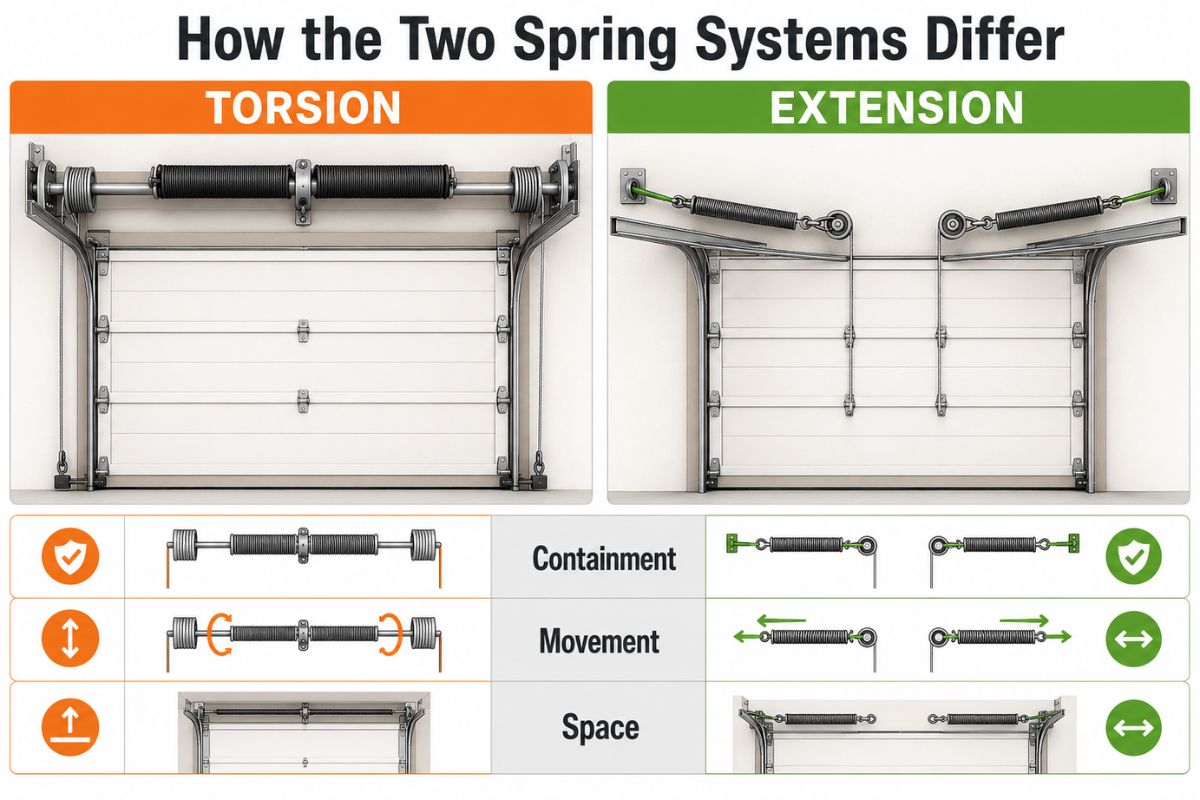
The most important differences are containment, balance, operating motion, required space and the design of the existing door system.
- Force distribution: A torsion shaft helps coordinate cable movement across the door. Extension springs operate as separate assemblies on the left and right.
- Failure containment: A torsion spring normally remains around its shaft if it breaks. An extension spring can become a projectile if it fails without a safety cable.
- Operating motion: Torsion systems commonly produce smoother, more controlled travel. Extension systems have more moving connections, including pulleys and longer cable routes.
- Space: Torsion hardware needs suitable structure and clearance above the opening. Extension hardware uses space alongside the tracks and may fit some low-headroom configurations.
- System compatibility: Spring selection must match the complete door assembly. Adding insulation, glass or reinforcement changes door weight and can make an existing spring specification incorrect.
Torsion vs Extension Springs: Which System Is Safer?
Torsion springs are generally considered the safer configuration because a failed spring normally stays contained on its shaft. Industry guidance specifically says that extension springs need safety cables running through them and secured at both ends to help contain a broken spring.
That does not make a torsion system harmless. The winding cones, shaft, drums, bottom brackets and lift cables can all be under dangerous tension. A loose winding bar, incorrect part or uncontrolled release can cause severe injury. Spring winding, cable replacement and bottom-bracket work belong to a trained door-systems technician.
An extension system should not be operated if a containment cable is missing, loose, damaged or incorrectly routed. A professional should inspect the complete system, including the pulleys, sheaves, cables, attachment points and matching of the left and right springs.
Which Spring System Is Better for Your Home?
For many homes, torsion springs are the stronger overall choice because they usually offer smoother movement, better side-to-side balance and a contained failure mode. The final decision must still be based on the door and garage—not on a universal rule.
Choose based on the complete door system
A technician should identify the door’s actual weight, height, track radius, drum configuration, available headroom and current hardware. A wide double door, a door with heavy insulation or a door with added glass may require a different spring specification from a lightweight single-car door.
Consider the space above and beside the door
A standard torsion setup requires appropriate support and clearance above the opening. Some garages with limited headroom may need a specialized configuration rather than a basic conversion. Extension springs occupy space near the horizontal tracks, which can affect storage and access around the ceiling.
Account for Arizona conditions
Heat and airborne dust in a Tempe or Metro Phoenix garage can expose metal components, bearings and moving joints to demanding conditions. Climate does not automatically determine which spring type is correct, but it makes periodic visual checks, balanced operation and manufacturer-appropriate maintenance important. Never use lubricant to disguise a broken spring, frayed cable or binding door.
Think about the opener as a separate component
A more powerful opener does not correct an incorrectly balanced door. The spring system should counterbalance the weight, while the opener controls movement. Continued opener use with a broken or weak spring can strain the operator and create unpredictable door movement. CallOrange’s garage door opener service can address operator problems, but the spring and door balance must be evaluated first.
What Warning Signs Mean You Should Stop Using the Door?
Stop cycling the door when its movement is uneven, unusually heavy or visibly compromised. Repeated operation can worsen damage and put people, vehicles and nearby property at risk.
- A visible gap in a torsion spring coil
- An extension spring that appears stretched, distorted or separated
- A missing or damaged extension-spring safety cable
- A frayed, loose or hanging lift cable
- One side of the door sitting higher than the other
- The door lifting only a few inches and stopping
- A loud snap followed by a heavy or immobile door
- A cable leaving its drum or pulley
- A bent track, damaged bottom bracket or door section out of position
You may visually inspect the system from the garage floor with the door fully closed and without touching the hardware. If the door is already open and a spring or cable appears damaged, do not stand beneath it or pull the emergency release. The safest next step is to keep the area clear.
When Does Spring Replacement or Conversion Make Sense?
Replacement is appropriate when a spring is broken, distorted, incorrectly sized or no longer balances the door. Conversion from extension to torsion may be worth evaluating when a homeowner wants improved containment, smoother movement or fewer moving pulley components and the garage has the structural support and clearance required.
A professional evaluation should confirm:
- The measured weight and dimensions of the door
- The correct spring specification and compatible hardware
- Header construction and mounting support
- Track, roller, hinge, cable and bottom-bracket condition
- Clearance for the shaft, drums and spring assembly
- Door balance and safety-reversal tests after service
If the door also has damaged rollers or cables, review CallOrange’s roller and cable replacement service. Track damage requires a separate alignment check through the track installation and alignment service. A damaged section may also need panel replacement before the system can be balanced correctly.
Frequently Asked Questions — Torsion vs. Extension Springs
Choosing the Right Spring System for Your Arizona Home
In the torsion vs extension springs comparison, torsion usually provides the better combination of containment, coordinated balance and controlled movement. The safest choice is still the system correctly engineered for the door and installed as a complete assembly. Learn more about CallOrange Garage Door Repair, review our torsion spring service, or contact our team for an inspection in Tempe and Metro Phoenix. Call (480) 690-3344 or view our Google Business Profile for location information.