
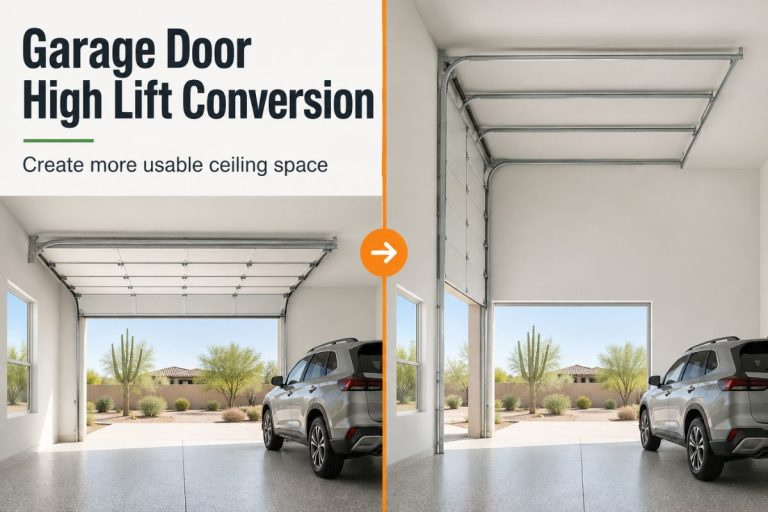
Standard-lift and high-lift garage door tracks compared inside a tall residential garage

Maximize Your Ceiling Space: The Ultimate Guide to High Lift Conversions

A garage door high lift conversion changes the track path so the door travels farther up the wall before turning toward the ceiling. The conversion can free overhead space for a vehicle lift, storage or lighting, but it requires compatible track geometry, counterbalance hardware, cables, drums and an opener selected for the finished system.
What Is a Garage Door High Lift Conversion?

Standard lift vs. high lift
FeatureStandard-lift systemHigh-lift system
Door pathTurns toward the ceiling shortly above the openingRises farther vertically before turning
Horizontal track heightRelatively close to the top of the openingPositioned higher in the garage
Typical purposeConventional vehicle accessVehicle lift clearance or usable overhead space
CounterbalanceHardware specified for standard-lift geometryRecalculated springs, cables and drums may be required
Opener layoutCeiling-mounted drawbar is commonA compatible wall-mount operator is often evaluated
High lift is not the same as full vertical lift. High-lift track raises the door vertically for an additional distance, then transitions to horizontal track.

In a standard residential setup, the vertical track curves toward a horizontal track soon after the top of the door clears the opening. High-lift track extends the vertical portion and moves that curve upward. The open door therefore rests closer to the ceiling instead of occupying the space immediately above the header.

The conversion is a redesign of the complete operating system—not an extension bolted onto the existing track. The door sections still travel through rollers, but the changed path affects cable travel, drum selection, spring calculations, track support and opener compatibility.

Direct answer: A high-lift conversion raises the horizontal tracks and keeps the door moving vertically for longer. It can reclaim ceiling volume, but only after the door, framing, track path, spring system, drums, cables and opener have been evaluated as one engineered assembly.

What Space Can a High-Lift Conversion Create?

The main benefit is usable clearance between the open door and the garage floor. How that space can be used depends on the finished track height, door position, building structure and the clearances required by any equipment.

Vehicle lift clearance

Car enthusiasts often consider high lift before installing a two-post or four-post vehicle lift. Raising the tracks can keep the open door above a raised vehicle. The garage-door plan and vehicle-lift plan must be coordinated so the door, opener, lift, vehicle and ceiling fixtures do not enter one another’s operating envelopes.

Overhead storage and equipment

Moving the door path upward may provide better placement options for storage racks, lighting or workshop equipment. Nothing should be installed where it interferes with the door, tracks, springs, cables, opener or required service access. Storage loads must also be supported by the building structure, not the garage-door track supports.

A cleaner ceiling layout

A compatible wall-mounted opener can remove a center ceiling rail from the garage. LiftMaster describes wall-mount openers as a way to optimize overhead space, but compatibility must be confirmed for the specific door geometry, shaft and operator model.

Diagram identifying tracks, torsion shaft, cable drums and wall-mounted opener in a high-lift garage door system
A high-lift plan coordinates the elevated track path with the counterbalance system, structural supports and compatible opener.

Is Your Garage a Good Candidate for High Lift?

A good candidate has meaningful unused height above the door, adequate structural support and a door system that can accept compatible high-lift hardware. A site measurement is necessary because ceiling height alone does not establish feasibility.

Key conditions to evaluate

  • Clear height between the top of the opening and the lowest obstruction
  • Door width, height, construction and measured weight
  • Ceiling slope, beams, soffits and roof framing
  • HVAC ducts, fire sprinklers, plumbing, electrical conduit and lighting
  • Current track radius, sideroom and backroom
  • Condition of door sections, hinges, rollers and reinforcement
  • Header and jamb structure available for track and spring supports
  • Opener location, compatibility and electrical access
  • Clearance required by a planned vehicle lift or storage system

Raynor defines high-lift track as hardware that causes the door to rise vertically above the opening before leveling into a horizontal position. Clopay likewise describes high-lift track as an option for garages with extra headroom. These definitions reinforce why the usable height above the opening—not just the overall ceiling height—matters.

Candidate check: A tall ceiling is only the starting point. Conversion feasibility depends on the lowest obstruction, the desired open-door position, the door’s actual weight, structural attachment points and compatible counterbalance and operator hardware.

Which Components Usually Change in a High-Lift Conversion?

The exact parts depend on the original door and the designed lift, but the conversion commonly affects more than the vertical tracks.

  1. Track assembly: High-lift vertical sections and an appropriate transition move the horizontal tracks upward.
  2. Track supports: New track positions require secure attachment to load-bearing structure and properly designed rear supports.
  3. Lift cables: The new travel path can require cables of a different length and specification.
  4. Cable drums: High-lift geometry may use drums designed to manage different cable travel as the door rises.
  5. Torsion springs: Spring selection and setup must be calculated for the door’s weight, travel and drum configuration.
  6. Torsion shaft and supports: Shaft position, bearing plates and mounting structure must suit the final layout.
  7. Opener and accessories: A wall-mount operator, cable-tension monitoring and other model-specific components may be considered.

Existing components cannot be assumed reusable because they appear undamaged. DASMA guidance treats the track, sections and connected hardware as a system, and manufacturer documentation should govern component compatibility. CallOrange’s track installation and alignment service provides the most relevant internal path for evaluating the guidance system.

Does a High-Lift Conversion Require a Wall-Mount Opener?

A wall-mount opener is often considered because it attaches beside the torsion shaft and removes the conventional drawbar rail from the center of the ceiling. It is not automatically compatible with every high-lift door.

The operator manufacturer’s requirements may address shaft configuration, drum position, door balance, cable tension, available side space and other limits. The chosen model must be approved for the completed door system. A ceiling-mounted opener may interfere with the new door path, while an incompatible wall-mount operator can create performance or safety problems.

Before retaining or changing an operator, the technician should confirm:

  • The approved door type and track configuration
  • The finished torsion-shaft layout
  • Available mounting and electrical space
  • Door balance throughout its travel
  • Required safety sensors and accessories
  • Manual release accessibility

Review available options through CallOrange’s garage door opener installation and repair service. Selection should follow the exact operator manual rather than a general horsepower assumption.

What Does a Professional High-Lift Evaluation Involve?

A professional evaluation converts the homeowner’s clearance goal into a measured system plan. It should identify constraints before springs are released or existing hardware is removed.

1. Define the desired clearance

The evaluator documents the purpose of the project, such as a specific vehicle lift, storage arrangement or unobstructed ceiling. Equipment dimensions and safe operating clearances should be available before the door layout is finalized.

2. Measure the opening and available space

Measurements cover the opening, headroom, sideroom, backroom and the lowest overhead obstruction. Ceiling slope and the locations of utilities are recorded because the door must have a clear, supported travel path.

3. Inspect the existing door

The sections, reinforcement, hinges, rollers, tracks, brackets, cables and counterbalance system are inspected. Damage or an incompatible door may need to be addressed before conversion. CallOrange’s panel replacement service may be relevant when a section is structurally compromised.

4. Specify the complete hardware system

The designed lift, door weight and track geometry inform the selection of tracks, drums, cables, springs, shaft hardware and supports. If the torsion system needs replacement or reconfiguration, see the torsion spring service.

5. Verify operation and safety after installation

The completed door must travel smoothly, remain properly balanced and operate with compatible safety devices. Track alignment, cable seating, limits and safety reversal are verified using the applicable manufacturer instructions.

Why Is High-Lift Conversion Not a DIY Project?

A conversion requires controlled work on springs, lift cables, drums, bottom brackets and load-bearing track supports. These components can store or transfer enough energy to cause severe injury. Incorrect geometry can also allow cables to lose tension, rollers to leave the track or the door to become unstable.

Safety boundary: Do not unwind torsion springs, loosen winding cones, remove bottom brackets, substitute drums, alter lift cables or relocate tracks as a homeowner project. Keep an unstable door closed and out of service, and have the proposed conversion measured and installed by a trained door-systems professional.

Online formulas and generic kits cannot account for every door, structure or opener. Even small changes to drum diameter, spring specification or track position alter how the door balances through its travel. The finished assembly must match approved components and documented installation requirements.

Frequently Asked Questions — Garage Door High Lift Conversion

What is a garage door high lift conversion? +

It changes the track system so the door rises farther vertically before turning toward the ceiling. This positions the open door and horizontal tracks higher, potentially creating clearance for a vehicle lift, storage or lighting. The conversion also requires evaluation of springs, drums, cables, supports and opener compatibility.

How much ceiling space can high lift create? +

The usable gain depends on the clear height above the opening, the lowest ceiling obstruction, track geometry and service clearance. There is no universal amount. A field measurement is needed to determine the safe finished track height and the position of the open door.

Is high lift the same as vertical lift? +

No. A high-lift door rises vertically for an additional distance and then follows horizontal track. A full vertical-lift door continues upward without the same horizontal storage position. The building height, door system and intended application determine which track configuration is appropriate.

Can my existing garage door be converted? +

Many sectional doors can be evaluated for conversion, but suitability depends on door construction, condition, weight, reinforcement, available headroom and compatible hardware. A damaged or incompatible door may need repair or replacement before a high-lift system can be designed.

Do I need a new garage door opener? +

Possibly. A standard ceiling-mounted rail may conflict with the raised door path. A compatible wall-mounted operator is often considered, but the exact model must be approved for the completed track, shaft, drum and door configuration. Existing opener compatibility should be verified rather than assumed.

Will the torsion springs need to change? +

They may. High-lift geometry changes cable travel and can require different drums, cables and spring calculations. A professional must use the measured door weight and complete designed configuration to specify the counterbalance system. Existing springs should not be reused solely because they appear intact.

Can high lift work with a sloped ceiling? +

A sloped ceiling does not automatically rule it out, but the track path, support points and opener arrangement need a site-specific design. In some garages, a follow-the-roof track may be evaluated. The correct configuration depends on framing and unobstructed travel clearance.

Is high lift useful without a vehicle lift? +

Yes. Homeowners may use the additional overhead clearance for lighting, storage planning, workshop equipment or a cleaner ceiling layout. The benefit should justify the system changes, and any new equipment must remain outside the door’s operating and service zones.

Can I use a universal high-lift conversion kit? +

A generic kit should not be treated as universally compatible. Door weight, dimensions, track layout, drums, cables, spring specification and structure must work together. Parts should be selected from verified manufacturer information for the exact designed system and installed by a trained professional.

What should I prepare for an evaluation? +

Explain how you plan to use the space and provide specifications for any vehicle lift, rack or equipment being considered. Keep the area accessible so the opening, ceiling, obstructions, tracks and door can be measured. Do not remove or adjust existing hardware beforehand.

Planning Your High-Lift Conversion in Tempe or Metro Phoenix

A successful garage door high lift conversion begins with the desired clearance and ends with a properly balanced, supported and tested door system. It should never begin with a generic parts list. Explore CallOrange’s garage door services, request an evaluation, or call (480) 690-3344. You can also view the CallOrange Google Business Profile for location information.

garage door installation

Garage Door Installation: What to Expect from a Professional Service

Installing a new garage door is one of the most important upgrades you can make to your home. It improves curb appeal, enhances security, increases energy efficiency, and ensures reliable daily operation. But many homeowners in Mesa, Phoenix, Tempe, and Scottsdale are unsure what the professional installation process actually involves.

Is it completed in one day?
What components are replaced?
How do you know you’re hiring the right company?

In this complete guide, we explain exactly what to expect from a professional garage door installation and why working with experienced technicians like Call Orange Garage Repair makes all the difference.

For full service details, visit:
https://callorange-garage-repair.com/

Why Professional Garage Door Installation Matters

A garage door is not just a panel that opens and closes. It is a system made up of:

  • Tracks

  • Rollers

  • Torsion springs

  • Hinges

  • Cables

  • Panels

  • Opener motor

  • Safety sensors

Improper installation can lead to:

  • Premature torsion spring replacement

  • Garage door track repair issues

  • Uneven movement

  • Opener strain

  • Safety risks

Professional installation ensures the entire system is properly aligned, balanced, and secured.

Step 1: Initial Consultation & Inspection

Before installation begins, a professional technician evaluates:

  • Garage opening dimensions

  • Headroom and side clearance

  • Existing track condition

  • Opener compatibility

  • Insulation needs

In Arizona cities like Phoenix and Scottsdale, heat resistance and insulation are especially important.

If older components are worn, the technician may recommend:

  • Garage door track alignment

  • Garage door roller replacement

  • Garage door spring repair

This ensures your new system operates smoothly from day one.

Step 2: Removal of the Old Door (If Applicable)

If replacing an existing unit, professionals will safely remove:

  • Panels

  • Torsion springs

  • Tracks

  • Rollers

  • Cables

Old spring systems require careful handling due to high tension. This is why torsion spring replacement should never be a DIY task.

Learn more about spring services here:
https://callorange-garage-repair.com/services/torsion-spring/

Step 3: Installation of Tracks & Hardware

The new system begins with precise installation of vertical and horizontal tracks. Proper garage door track alignment is critical.

Incorrect alignment can cause:

  • Shaking

  • Grinding

  • Off-track movement

  • Premature wear

Professional garage door track repair and installation ensure smooth motion and balanced operation.

Track services are available here:
https://callorange-garage-repair.com/services/track-services/

Step 4: Panel Assembly & Secure Mounting

New panels are carefully assembled and secured section by section.

High-quality garage door panel replacement and installation ensure:

  • Proper weight distribution

  • Strong structural support

  • Weather resistance

  • Improved insulation

Panel services can be reviewed here:
https://callorange-garage-repair.com/services/panel-replacement/

Step 5: Spring System Installation

The torsion spring system is the heart of your garage door.

During installation:

  • Springs are calibrated to door weight

  • Proper tension is applied

  • Balance is tested manually

If improperly installed, you may soon require garage door spring repair or experience unsafe operation.

Professionally balanced springs reduce strain on the opener and extend system lifespan.

Step 6: Roller & Cable Installation

New rollers are installed to ensure smooth, quiet movement.

Upgrading to premium nylon rollers significantly reduces noise—especially important in attached garages in Tempe and Mesa homes.

Professional garage door roller replacement ensures long-term durability.

Roller services available here:
https://callorange-garage-repair.com/services/roller-replacement/

Step 7: Garage Door Opener Installation & Testing

If replacing or installing a new opener, technicians will:

  • Mount the motor unit

  • Install safety sensors

  • Connect wall controls

  • Program remotes

  • Test force settings

Modern garage door opener installation provides:

  • Quiet belt-drive systems

  • Smart WiFi access

  • Battery backup

  • Enhanced safety features

Learn about opener services here:
https://callorange-garage-repair.com/services/garage-door-opener-installation/

Step 8: Full Safety Inspection & Performance Testing

After installation, professionals conduct a complete garage door inspection, checking:

  • Balance

  • Auto-reverse function

  • Sensor alignment

  • Track smoothness

  • Spring tension

  • Cable security

This ensures safe and reliable operation.

Regular garage door maintenance after installation keeps the system operating efficiently for years.

How Long Does Professional Installation Take?

In most residential cases:

  • Standard installation: 3–6 hours

  • Complex replacements: Same-day completion

Call Orange Garage Repair offers same day garage door service across Mesa, Phoenix, Tempe, and Scottsdale whenever possible.

Signs You Need a New Garage Door Installation

You may need professional installation if:

  • Frequent garage door track repair is required

  • Multiple torsion spring replacement cycles have occurred

  • Panels are severely damaged

  • Opener fails repeatedly

  • The door is over 15–20 years old

If unsure, schedule an inspection here:
https://callorange-garage-repair.com/contact-us/

Benefits of Professional Installation

Homeowners choosing professional garage door installation gain:

Increased Security

Stronger locking mechanisms and durable panels.

Better Energy Efficiency

Improved insulation reduces Arizona heat intrusion.

Reduced Noise

Proper garage door roller replacement and track alignment eliminate vibration.

Longer Lifespan

Balanced torsion springs reduce system stress.

Lower Long-Term Costs

Avoid recurring emergency garage door repair.

Why Homeowners Trust Call Orange Garage Repair

Across Mesa, Phoenix, Tempe, and Scottsdale, homeowners choose Call Orange Garage Repair for:

  • Skilled residential technicians

  • Transparent pricing

  • Affordable garage door repair options

  • Same day garage door service

  • Emergency garage door repair availability

  • High-quality installation materials

Learn more about their commitment to excellence here:
https://callorange-garage-repair.com/about-us/

Invest in Professional Garage Door Installation for Long-Term Reliability

A garage door installation is not just a cosmetic upgrade—it is a safety, security, and performance investment. From precise garage door track alignment to proper torsion spring calibration and professional garage door opener installation, every step must be executed correctly.

Attempting shortcuts or hiring inexperienced installers can result in ongoing garage door spring repair, misalignment issues, noisy rollers, or emergency breakdowns.

Homeowners in Mesa, Phoenix, Tempe, Scottsdale, and surrounding Arizona communities deserve a garage door system that operates smoothly, safely, and reliably every day.

If you’re planning a new garage door installation or replacing an aging system, trust the experienced professionals at Call Orange Garage Repair.

Schedule your professional installation today:
https://callorange-garage-repair.com/contact-us/

Upgrade your home. Improve safety. Enhance curb appeal. And enjoy peace of mind with expert garage door installation done right the first time.