
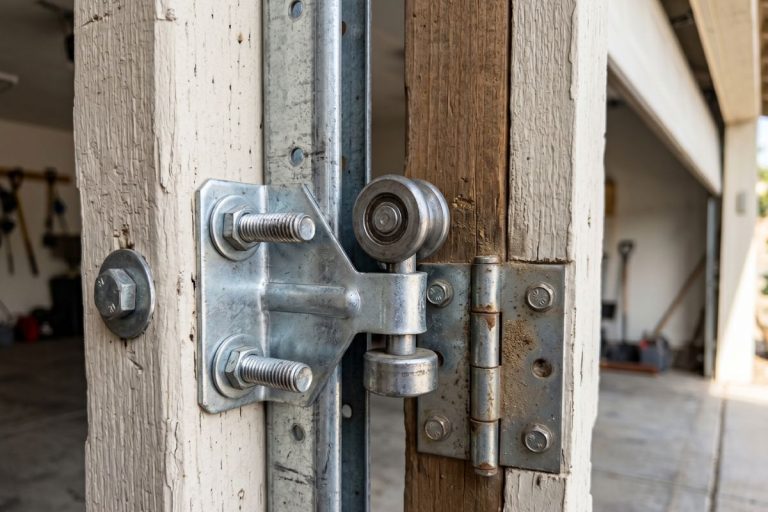
Garage door maintenance tips

How to Tighten Loose Garage Door Hardware: Garage Door Maintenance Tips for Mesa Homeowners

Loose garage door hardware in Mesa is almost always caused by daily vibration cycles compounded by Arizona’s heat expansion — not poor installation. Every open-and-close cycle sends micro-vibrations through hinges, lag bolts, track brackets, and roller brackets. Combined with 110°F+ summer expansion and contraction, fasteners back out over months. A trained technician torques each fastener to spec, replaces stripped hardware, and verifies door balance.

We’ve been servicing residential and commercial garage doors across Mesa and the entire Metro Phoenix area for years, and one truth shows up on nearly every tune-up call we run: hardware that was tight on installation day is no longer tight after two summers in the desert. Homeowners notice rattling, a slight wobble in the panels, or a louder open cycle, and they assume it’s a roller or spring issue. More often, it’s just hardware that’s worked itself loose.

The fix isn’t complicated, but it does need to be done correctly — over-tightening strips bolts, under-tightening leaves the door unsafe, and ignoring it altogether stresses the spring system, the opener carriage, and the tracks. That’s why we walk every customer through what we check, what we tighten, and what we leave alone. Our residential garage door technicians have run this exact maintenance pass on doors in Mesa, Tempe, Gilbert, Chandler, and Scottsdale, and we know which fasteners loosen first in this climate. You can also find us on Google Maps to see where we’re based and read verified reviews from East Valley homeowners.

This guide explains exactly which garage door hardware loosens, why it happens in Mesa specifically, what we check during a professional tune-up, and which steps you should leave to a technician. By the end, you’ll know the difference between routine maintenance you can handle and high-tension components that genuinely require trained hands.

Why Garage Door Hardware Loosens in Mesa, Arizona

A standard residential garage door cycles between 1,500 and 2,000 times per year. Every cycle sends vibration through more than 50 fasteners — lag bolts in the track brackets, hinge bolts on the panels, motor mounting bolts, opener rail bolts, and the carriage assembly hardware. Multiply that by Arizona’s thermal swing — overnight lows in the 60s climbing to afternoon highs above 110°F — and the metal expands and contracts every single day.

That expansion-contraction cycle is the silent enemy of garage door hardware in Mesa. Steel bolts threaded into wooden door panels or wooden header framing experience a slightly different rate of expansion than the surrounding material. Over months, the threads work themselves microscopically looser. Add the constant downward pull of gravity on a 150–250 pound door, and the result is hardware that backs out one half-turn at a time until something rattles, shakes, or fails.

We see this pattern most often on doors that are 5+ years old and have never had a professional tune-up. The owner has been operating the door normally, opening it three or four times a day, and the hardware has been quietly working itself loose the entire time. By the time they call us, the hinges are walking, the track brackets are flexing under load, and the rollers are running rough because the tracks are no longer perfectly parallel.

Mesa-specific stressors that accelerate this:

  • Daytime thermal expansion — torsion bars, lift cables, and tracks expand differently than the wood frame they’re bolted to
  • UV degradation of plastic roller wheels and rubber bottom seals, which changes the load distribution on the hardware
  • Fine desert dust that works into hinge knuckles and roller bearings, increasing friction and vibration
  • Monsoon humidity swings that cause subtle wood expansion in the header and jambs
  • High-cycle households with multiple drivers using the door 6–10 times per day

Understanding these conditions is part of why our team approaches Mesa garage doors differently than a national franchise might. We’re a local operation — based at 2101 E Broadway Rd in Tempe — and our technicians live in this climate. If you’d like to schedule an inspection, you can reach our Mesa-area service team directly.

Symptom Likely Cause What a Pro Checks
Rattling sound during operation Loose track brackets or roller carriers Torque check on every lag bolt and bracket fastener
Visible wobble in the panels Hinge bolts backed out or stripped Inspect each hinge, replace stripped hardware
Door drifts off-center as it travels Track misalignment from loose mounting Plumb-and-level track check, re-secure to jamb
Opener rail vibrates loudly Loose ceiling brackets or motor mount Re-anchor lag bolts into ceiling joists
Roller noise on one side only Loose hinge or bent roller bracket Hinge torque + roller bracket inspection
Bottom panel feels loose Bottom bracket fasteners loose or stripped Professional only — high cable tension zone
Door bounces at full open Loose horizontal track angle iron Ceiling angle iron re-tightening + alignment


The Hardware We Check on Every Garage Door Tune-Up

When our technicians arrive for a residential garage door maintenance appointment, we follow the same checklist on every door — regardless of brand or age. Consistency is what separates a real tune-up from someone just walking around with a wrench. Below is the order we work through.

Hinge Bolts on Each Panel

Every panel section is connected by hinges, and each hinge is held in place by 4 to 8 bolts depending on configuration. We torque-check every hinge bolt by hand using the proper sized socket — never an impact driver, which strips hardware in seconds. If a bolt spins freely without grabbing, the hole is stripped, and we replace the hardware with a slightly longer self-tapping fastener that bites into fresh material.

Track Brackets and Jamb Hardware

Vertical tracks are anchored to the door jamb with lag bolts spaced every 18–24 inches. These take the brunt of the door’s weight transfer during opening and closing. Loose track brackets are the single most common cause of off-center door travel and are often the underlying reason customers call us about track alignment issues. We tighten each lag bolt to spec and shim where needed.

Horizontal Track and Ceiling Angle Iron

The horizontal portion of the track runs back into the garage and is supported by angle iron that bolts into the ceiling joists. When these mounts loosen, the door bounces at the top of its travel and the rollers chatter. We check every ceiling-mounted lag bolt and re-anchor any that have backed out.

Opener Mounting Hardware

The opener motor unit is suspended from the ceiling with steel hangers and lag bolts. We check the motor mount, the rail mounting bracket above the door header, and every connection in between. Loose opener mounting is what causes the loud vibration sound that homeowners often mistake for a failing motor.

Roller Brackets and Stem Hinges

Each roller sits in a bracket that’s part of a hinge or a dedicated roller carrier. We inspect each one for cracks, bending, and loose attachment. Bent roller brackets are usually replaced rather than tightened — a bent bracket means the roller is no longer running true in the track, and torquing the bolt won’t fix the geometry.

Bottom Brackets — Hands Off Without Training

The bottom corner brackets attach the lift cables to the door. These brackets are under direct cable tension whenever the door is closed. A loose bottom bracket is one of the most dangerous hardware conditions on a garage door — it can release suddenly under load and cause serious injury. We never recommend customers touch these. If you suspect a bottom bracket issue, leave the door alone and call our team. This is part of why our garage door cable services always include a bottom bracket inspection.

Lift Cables and Cable Drum Set Screws

Above the door, the cable drums sit on the torsion shaft and are held by set screws. These can loosen over time — especially in high-cycle households — and require torquing while the spring is properly secured. This is professional-only work because it sits inside the live tension system. The same applies to torsion spring hardware, which we never let homeowners touch.

Hardware Tightening You Can Safely Handle Yourself

Not everything on a garage door requires a technician. There’s a clear line between routine homeowner maintenance and tension-loaded work. Here’s what falls on the safe side of that line:

  • Hinge bolts on the panels (top hinges between sections, not the bottom corner brackets) — a hand wrench, snug to firm, no impact driver
  • Visible track brackets along the vertical track — check that lag bolts haven’t backed out
  • Ceiling-mounted opener brackets and rail hangers — visual inspection and gentle hand-tightening
  • Roller hinge bolts at the top and middle sections of the door
  • Photo-eye sensor mounting brackets at the base of each track

What you should never touch without training: the bottom brackets, the lift cables, the torsion springs, the cable drums, the spring shaft, or any fastener that’s currently bearing tension. The energy stored in a wound torsion spring can cause life-changing injuries. We’ve seen the aftermath of DIY spring work on calls across Mesa, Tempe, Chandler, Gilbert, and Scottsdale, and we’d rather give honest advice than show up to clean up a preventable accident.

If you’re not sure whether a fastener is in the safe zone or the tension zone, the answer is to leave it. Our pricing for a complete tune-up is far less than a single ER visit, and we provide written estimates before we start any work. You can reach us through our contact page or call (480) 690-3344.

Our Garage Door Hardware Tune-Up Process — Step by Step

Every service call we run for hardware tightening follows the same process. Consistency protects the customer and protects the door.

Step 1: Visual Inspection and Door Balance Test

Before touching a single fastener, our technician disconnects the opener and manually raises the door to halfway. A properly balanced door holds its position. If it drifts up or down, the spring system is the underlying issue and tightening hardware won’t fix it. We document the balance result and discuss next steps with the customer before proceeding.

Step 2: Top-Down Hardware Walk

We start at the top of the door — the topmost hinge, the strut bracket if present, the lift handle plate — and work our way down section by section. Every fastener gets a hands-on torque check. Anything stripped is replaced on the spot from the inventory we carry on our service vehicles. This avoids return trips and keeps the job to a single visit.

Step 3: Track Alignment Verification

After the panel hardware is tight, we move to the tracks. We check that the vertical tracks are plumb, the horizontal tracks are level, and the spacing between the two sides matches at every measurement point. Loose hardware often hides a track that’s drifted out of true alignment. Tightening without correcting alignment is a half-job. Our track installation and alignment service handles this in detail when needed.

Step 4: Opener and Rail Inspection

We move to the opener — checking the motor mount, the rail header bracket, the trolley carriage, and the safety beam sensors. Loose opener hardware is what causes the constant low-frequency rumble that homeowners learn to ignore. Once tightened, the difference in operating noise is immediate. Our garage door opener service includes this same hardware check on every visit.

Step 5: Lubrication of Moving Parts

After the hardware is locked down, we lubricate the rollers, hinges, and torsion bar bushings with a garage-door-specific synthetic lubricant. We do not use WD-40 — it’s a solvent, not a lubricant, and it actually strips existing grease. The right product is silicone or lithium-based and rated for high-cycle use.

Step 6: Auto-Reverse and Safety Test

We finish by testing the auto-reverse safety feature with a 2×4 placed flat under the door. The door should reverse on contact within two seconds. We test the photo-eye sensors by breaking the beam during a close cycle. If anything fails, we troubleshoot before we leave. Safety testing is part of every visit — non-negotiable.

Step 7: Customer Walkthrough and Written Summary

Before we leave, we walk the customer through what we found, what we tightened, what we replaced, and what we recommend monitoring. We provide a written summary they can keep for their records. Transparency matters to us — it’s part of how we’ve built our reputation across the East Valley.

Why Garage Door Maintenance Tips Matter for Long-Term Door Life

A garage door that’s properly tightened and tuned doesn’t just sound better — it lasts longer. Loose hardware is a silent multiplier of wear. When hinges flex during operation, the panel sections grind against each other and the paint chips at the seams. When tracks aren’t tight, rollers wear unevenly and need replacement years earlier than they should. When the opener mount vibrates, the gear train inside the motor wears prematurely.

We’ve serviced doors in Mesa where ten minutes of hardware tightening would have saved the homeowner a $400 roller replacement two years later. We’ve also seen doors where a loose torsion bracket led to a spring failure that took the cable and the bottom panel with it. The cost of routine maintenance is always lower than the cost of a chain-reaction failure.

Our recommendation for Mesa homeowners: a professional tune-up once a year, ideally before the worst of summer in May or June. The thermal stress between June and September is the highest of the year, and a door that goes into summer with tight hardware is far more likely to come out of summer in good shape. If you’ve gone more than two years without service, you’re due. You can book your tune-up appointment directly with our team.

We’re a real local business — not a national lead-resale operation. Our address is 2101 E Broadway Rd Ste 3, Tempe, AZ 85282, and our technicians work the East Valley exclusively. You can verify our location and read homeowner reviews on our Google Maps listing. When you call (480) 690-3344, you reach our team — not a national call center routing the lead to whoever bid lowest that hour.

Frequently Asked Questions — Garage Door Maintenance in Mesa, AZ

How often should I have my garage door hardware tightened in Mesa?
For most Mesa homeowners, once a year is the right cadence — ideally in late spring before summer heat stress peaks. High-cycle households with multiple drivers may benefit from a tune-up every 8–9 months. If you hear new rattles or notice the door shaking during operation, don’t wait for the calendar — schedule sooner.

Can I just tighten the hinges myself with a wrench?
The hinges between panel sections (not the bottom brackets) are reasonably safe for a homeowner to snug with a hand wrench. Use a proper sized socket, never an impact driver, and stop when the bolt is firm — over-tightening strips the threads. Avoid the bottom brackets, cables, springs, and drum set screws entirely. Those sit inside the tension system.

What’s the difference between loose hardware and a real spring problem?
Loose hardware causes rattling, vibration, and wobble during operation, but the door still feels balanced when you lift it manually. A spring problem makes the door feel suddenly heavy, fail to stay open at halfway, or close with a thud. If you’re unsure, our technicians run a manual balance test on every visit to tell you exactly which one you’re dealing with.

How much does a garage door tune-up cost in Mesa?
Pricing depends on the size of your door, the system type, and whether any hardware needs replacement. We provide a written estimate before starting any work — no surprises on the final invoice. A standard residential tune-up typically takes 45–75 minutes on-site. Call us at (480) 690-3344 for a specific quote based on your door.

Will tightening loose hardware quiet my noisy garage door?
In most cases, yes — significantly. A large portion of garage door noise comes from loose fasteners vibrating under load. Once we torque the hardware and lubricate the moving parts properly, customers consistently report the door sounds substantially quieter. If noise persists after a tune-up, the next likely culprit is worn rollers, which we can replace during the same visit.

Do you serve all of Mesa and the East Valley?
Yes — we cover Mesa, Gilbert, Chandler, Tempe, Scottsdale, Phoenix, and surrounding East Valley communities from our location at 2101 E Broadway Rd in Tempe. You can confirm we cover your neighborhood by calling (480) 690-3344, or visit our Google Maps listing for directions and verified reviews from local homeowners.

What hardware should never be tightened by a homeowner?
Three categories are strictly professional-only: bottom corner brackets (under live cable tension), torsion spring hardware including the spring cones and center bearing plate, and cable drum set screws on the torsion shaft. Each of these sits inside the high-tension load path and can release stored energy violently if mishandled. When in doubt, leave it alone and call our team.

Keeping Your Garage Door Tight, Quiet, and Safe in Mesa

Loose garage door hardware is one of those small, slow problems that quietly damages bigger components — the springs, the opener, the panels, the tracks. Most Mesa homeowners don’t notice it until the door is already shaking, rattling, or operating roughly. By that point, the hardware has been working itself loose for a year or more, and the secondary wear has already started.

The good news is that consistent maintenance reverses that trend. A proper tune-up — done by a technician who actually checks every fastener, tests door balance, verifies track alignment, and confirms safety reverse function — restores the door to factory-tight condition and adds years to the system’s lifespan. If you want to go deeper on related topics, our recent article on what to do when your garage door cable snaps walks through the next category up the urgency scale.

CallOrange Garage Door Repair is based at 2101 E Broadway Rd Ste 3 in Tempe, and we serve Mesa, Gilbert, Chandler, Scottsdale, Phoenix, and the surrounding East Valley. Our technicians are residential and commercial trained, our pricing is transparent with written estimates before we start, and our hours run 7 AM to 11 PM every day of the week. You can visit our location and read verified reviews on Google Maps to see what your neighbors have said about our work.

Call CallOrange Garage Door Repair today at (480) 690-3344 for a professional garage door tune-up in Mesa, AZ — or find us, get directions, and read our reviews on Google Maps and stop by our local listing. Our team is ready to handle your hardware tightening, balance check, and full safety inspection. Schedule your appointment online here and we’ll get your door tight, quiet, and operating the way it should.