
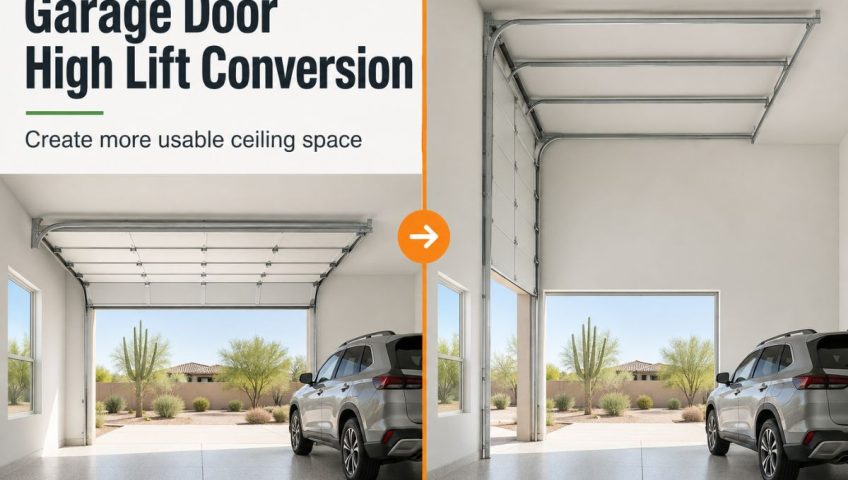
A garage door high lift conversion changes the track path so the door travels farther up the wall before turning toward the ceiling. The conversion can free overhead space for a vehicle lift, storage or lighting, but it requires compatible track geometry, counterbalance hardware, cables, drums and an opener selected for the finished system.
What Is a Garage Door High Lift Conversion?
| Feature | Standard-lift system | High-lift system |
|---|---|---|
| Door path | Turns toward the ceiling shortly above the opening | Rises farther vertically before turning |
| Horizontal track height | Relatively close to the top of the opening | Positioned higher in the garage |
| Typical purpose | Conventional vehicle access | Vehicle lift clearance or usable overhead space |
| Counterbalance | Hardware specified for standard-lift geometry | Recalculated springs, cables and drums may be required |
| Opener layout | Ceiling-mounted drawbar is common | A compatible wall-mount operator is often evaluated |
In a standard residential setup, the vertical track curves toward a horizontal track soon after the top of the door clears the opening. High-lift track extends the vertical portion and moves that curve upward. The open door therefore rests closer to the ceiling instead of occupying the space immediately above the header.
The conversion is a redesign of the complete operating system—not an extension bolted onto the existing track. The door sections still travel through rollers, but the changed path affects cable travel, drum selection, spring calculations, track support and opener compatibility.
What Space Can a High-Lift Conversion Create?
The main benefit is usable clearance between the open door and the garage floor. How that space can be used depends on the finished track height, door position, building structure and the clearances required by any equipment.
Vehicle lift clearance
Car enthusiasts often consider high lift before installing a two-post or four-post vehicle lift. Raising the tracks can keep the open door above a raised vehicle. The garage-door plan and vehicle-lift plan must be coordinated so the door, opener, lift, vehicle and ceiling fixtures do not enter one another’s operating envelopes.
Overhead storage and equipment
Moving the door path upward may provide better placement options for storage racks, lighting or workshop equipment. Nothing should be installed where it interferes with the door, tracks, springs, cables, opener or required service access. Storage loads must also be supported by the building structure, not the garage-door track supports.
A cleaner ceiling layout
A compatible wall-mounted opener can remove a center ceiling rail from the garage. LiftMaster describes wall-mount openers as a way to optimize overhead space, but compatibility must be confirmed for the specific door geometry, shaft and operator model.
Is Your Garage a Good Candidate for High Lift?
A good candidate has meaningful unused height above the door, adequate structural support and a door system that can accept compatible high-lift hardware. A site measurement is necessary because ceiling height alone does not establish feasibility.
Key conditions to evaluate
- Clear height between the top of the opening and the lowest obstruction
- Door width, height, construction and measured weight
- Ceiling slope, beams, soffits and roof framing
- HVAC ducts, fire sprinklers, plumbing, electrical conduit and lighting
- Current track radius, sideroom and backroom
- Condition of door sections, hinges, rollers and reinforcement
- Header and jamb structure available for track and spring supports
- Opener location, compatibility and electrical access
- Clearance required by a planned vehicle lift or storage system
Raynor defines high-lift track as hardware that causes the door to rise vertically above the opening before leveling into a horizontal position. Clopay likewise describes high-lift track as an option for garages with extra headroom. These definitions reinforce why the usable height above the opening—not just the overall ceiling height—matters.
Which Components Usually Change in a High-Lift Conversion?
The exact parts depend on the original door and the designed lift, but the conversion commonly affects more than the vertical tracks.
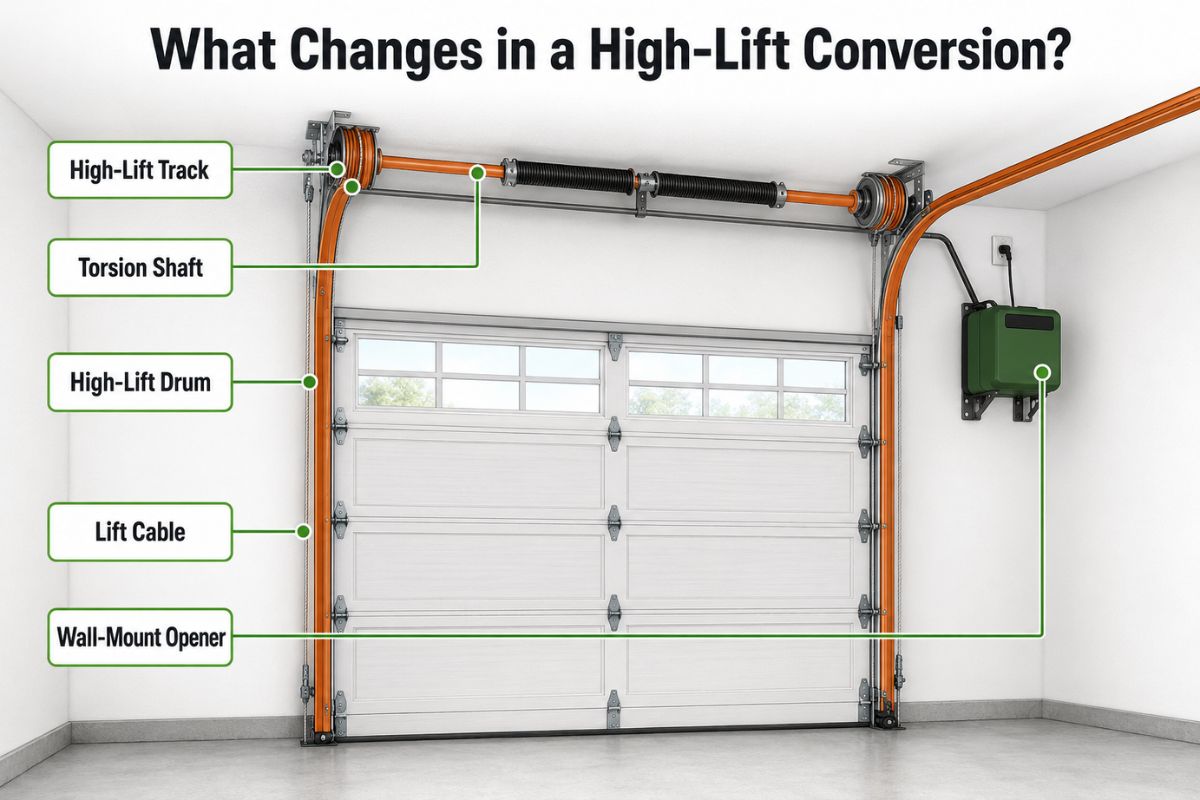
- Track assembly: High-lift vertical sections and an appropriate transition move the horizontal tracks upward.
- Track supports: New track positions require secure attachment to load-bearing structure and properly designed rear supports.
- Lift cables: The new travel path can require cables of a different length and specification.
- Cable drums: High-lift geometry may use drums designed to manage different cable travel as the door rises.
- Torsion springs: Spring selection and setup must be calculated for the door’s weight, travel and drum configuration.
- Torsion shaft and supports: Shaft position, bearing plates and mounting structure must suit the final layout.
- Opener and accessories: A wall-mount operator, cable-tension monitoring and other model-specific components may be considered.
Existing components cannot be assumed reusable because they appear undamaged. DASMA guidance treats the track, sections and connected hardware as a system, and manufacturer documentation should govern component compatibility. CallOrange’s track installation and alignment service provides the most relevant internal path for evaluating the guidance system.
Does a High-Lift Conversion Require a Wall-Mount Opener?
A wall-mount opener is often considered because it attaches beside the torsion shaft and removes the conventional drawbar rail from the center of the ceiling. It is not automatically compatible with every high-lift door.
The operator manufacturer’s requirements may address shaft configuration, drum position, door balance, cable tension, available side space and other limits. The chosen model must be approved for the completed door system. A ceiling-mounted opener may interfere with the new door path, while an incompatible wall-mount operator can create performance or safety problems.
Before retaining or changing an operator, the technician should confirm:
- The approved door type and track configuration
- The finished torsion-shaft layout
- Available mounting and electrical space
- Door balance throughout its travel
- Required safety sensors and accessories
- Manual release accessibility
Review available options through CallOrange’s garage door opener installation and repair service. Selection should follow the exact operator manual rather than a general horsepower assumption.
What Does a Professional High-Lift Evaluation Involve?
A professional evaluation converts the homeowner’s clearance goal into a measured system plan. It should identify constraints before springs are released or existing hardware is removed.
1. Define the desired clearance
The evaluator documents the purpose of the project, such as a specific vehicle lift, storage arrangement or unobstructed ceiling. Equipment dimensions and safe operating clearances should be available before the door layout is finalized.
2. Measure the opening and available space
Measurements cover the opening, headroom, sideroom, backroom and the lowest overhead obstruction. Ceiling slope and the locations of utilities are recorded because the door must have a clear, supported travel path.
3. Inspect the existing door
The sections, reinforcement, hinges, rollers, tracks, brackets, cables and counterbalance system are inspected. Damage or an incompatible door may need to be addressed before conversion. CallOrange’s panel replacement service may be relevant when a section is structurally compromised.
4. Specify the complete hardware system
The designed lift, door weight and track geometry inform the selection of tracks, drums, cables, springs, shaft hardware and supports. If the torsion system needs replacement or reconfiguration, see the torsion spring service.
5. Verify operation and safety after installation
The completed door must travel smoothly, remain properly balanced and operate with compatible safety devices. Track alignment, cable seating, limits and safety reversal are verified using the applicable manufacturer instructions.
Why Is High-Lift Conversion Not a DIY Project?
A conversion requires controlled work on springs, lift cables, drums, bottom brackets and load-bearing track supports. These components can store or transfer enough energy to cause severe injury. Incorrect geometry can also allow cables to lose tension, rollers to leave the track or the door to become unstable.
Online formulas and generic kits cannot account for every door, structure or opener. Even small changes to drum diameter, spring specification or track position alter how the door balances through its travel. The finished assembly must match approved components and documented installation requirements.
Frequently Asked Questions — Garage Door High Lift Conversion
Planning Your High-Lift Conversion in Tempe or Metro Phoenix
A successful garage door high lift conversion begins with the desired clearance and ends with a properly balanced, supported and tested door system. It should never begin with a generic parts list. Explore CallOrange’s garage door services, request an evaluation, or call (480) 690-3344. You can also view the CallOrange Google Business Profile for location information.